Top 10 Countries Sending Remittances to Pakistan in 2026
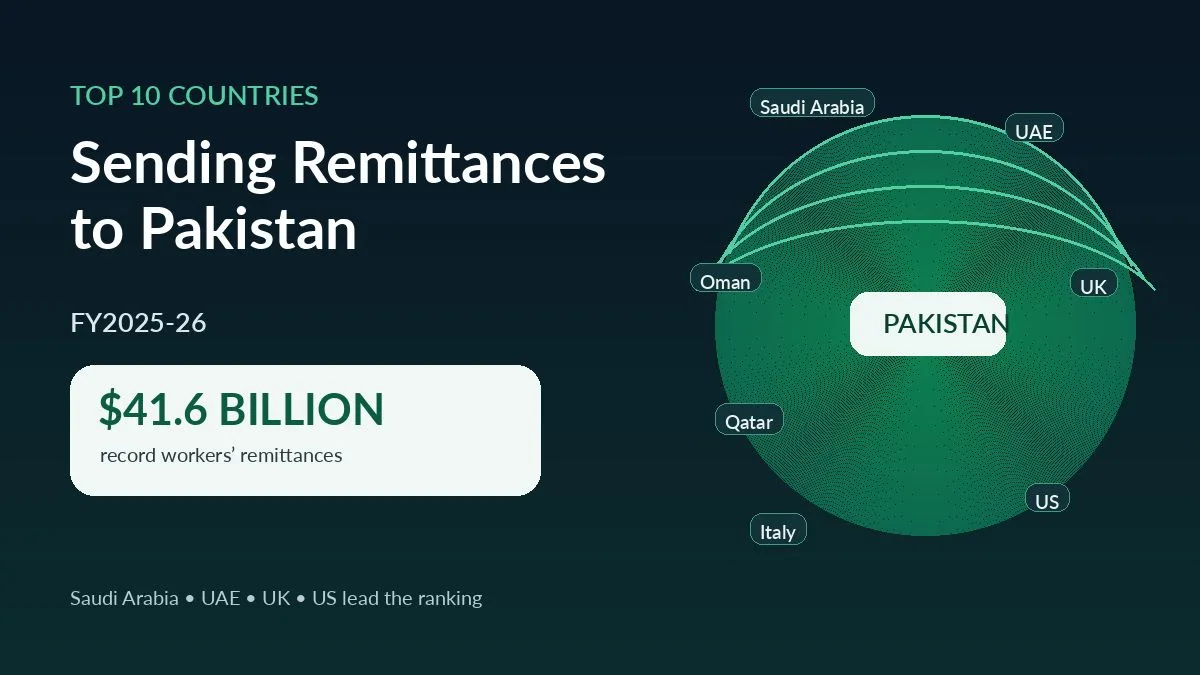
Pakistan received a record $41.585 billion in workers’ remittances during fiscal year 2025-26 (FY26), according to State Bank of Pakistan data. That was about 8.6% higher than the $38.3 billion received in FY25 and marked the strongest annual remittance inflow on record.
The largest remittance corridors remained concentrated in the Gulf, the United Kingdom and the United States, but several European and Asia-Pacific countries also contributed more than $1 billion during the year.
For this ranking, Economy.pk treats a country as a country. Regional categories such as “European Union countries” and “Other GCC countries” are not ranked as if they were individual countries. Where the SBP’s headline FY26 release grouped Gulf countries together, Economy.pk reconstructed the full-year totals for Oman, Qatar and Kuwait from the SBP-backed July–March data plus April, May and June 2026 country figures. Those reconstructed figures are rounded.
Top 10 Countries Sending Remittances to Pakistan in FY2025-26
Rank | Country | Remittances to Pakistan | Share of FY26 total |
|---|---|---|---|
1 | Saudi Arabia | $9.783 billion | 23.53% |
2 | United Arab Emirates | $8.807 billion | 21.18% |
3 | United Kingdom | $6.326 billion | 15.21% |
4 | United States | $3.624 billion | 8.71% |
5 | Italy | $1.547 billion | 3.72% |
6 | Oman | $1.294 billion | 3.11% |
7 | Qatar | $1.175 billion | 2.83% |
8 | Australia | $1.142 billion | 2.75% |
9 | Spain | $0.906 billion | 2.18% |
10 | Kuwait | $0.890 billion | 2.14% |
Together, these ten countries accounted for approximately $35.5 billion, or about 85.4% of Pakistan’s total workers’ remittances in FY26.
1. Saudi Arabia — $9.78 Billion
Saudi Arabia was Pakistan’s largest source of workers’ remittances in FY26, sending approximately $9.783 billion. That represented about 23.5% of Pakistan’s total remittance inflows for the year.
The corridor remains dominant because Saudi Arabia hosts a large Pakistani workforce across construction, transport, retail, hospitality, healthcare, engineering and professional services. Remittance flows from the kingdom also benefit from long-established banking and exchange-company channels linking Saudi Arabia with Pakistan.
Saudi Arabia’s lead is significant: the country alone contributed almost one quarter of all formal workers’ remittances received by Pakistan in FY26.
2. United Arab Emirates — $8.81 Billion
The United Arab Emirates ranked second, with approximately $8.807 billion sent to Pakistan during FY26. That was roughly 21.2% of the annual total.
Dubai and Abu Dhabi are major employment and business hubs for overseas Pakistanis, while Sharjah and the other emirates also contribute to the corridor. The UAE’s geographic proximity to Pakistan, strong aviation links and large Pakistani expatriate community make it one of the country’s most important sources of household foreign-currency inflows.
Combined, Saudi Arabia and the UAE were responsible for almost 45% of Pakistan’s FY26 remittances.
3. United Kingdom — $6.33 Billion
The United Kingdom was the third-largest source, contributing about $6.326 billion in FY26, equal to approximately 15.2% of Pakistan’s total remittances.
The UK-Pakistan remittance corridor is supported by a large and established British Pakistani community. Unlike many Gulf corridors that are closely linked to temporary employment, remittances from the UK also reflect long-term family and community ties, business relationships and intergenerational connections with Pakistan.
The UK remained Pakistan’s largest remittance source outside the Gulf region.
4. United States — $3.62 Billion
Pakistan received approximately $3.624 billion in workers’ remittances from the United States during FY26, placing the US fourth.
The US accounted for about 8.7% of annual remittances. Although FY26 inflows from the United States were slightly lower than the previous fiscal year, the corridor remained one of Pakistan’s most valuable because of the size and earning capacity of the Pakistani diaspora in North America.
5. Italy — $1.55 Billion
Italy ranked fifth with approximately $1.547 billion in remittances to Pakistan during FY26.
Italy was the largest individual source within the European Union in the SBP-backed country breakdown. Pakistani communities in Italy are active across manufacturing, agriculture, logistics, retail and small business, helping make Italy an increasingly important remittance corridor.
Its FY26 inflows were larger than those from any individual GCC country outside Saudi Arabia and the UAE except Oman.
6. Oman — About $1.29 Billion
Oman sent an estimated $1.294 billion to Pakistan in FY26, placing it sixth in this country-only ranking.
The figure is reconstructed from official SBP-backed data: approximately $955.0 million during July–March FY26, followed by about $94.7 million in April, $133.2 million in May and $110.8 million in June.
Oman has long employed Pakistani workers in construction, transport, engineering, retail, services and energy-related industries, making it one of Pakistan’s most durable Gulf remittance corridors.
7. Qatar — About $1.18 Billion
Qatar ranked seventh, with an estimated $1.175 billion in FY26 remittances.
The estimate combines about $855.5 million in July–March with roughly $105.4 million in April, $118.6 million in May and $95.9 million in June.
Qatar’s demand for expatriate labour and professional workers continues to support remittance flows to Pakistan, particularly from construction, services, hospitality, transport and technical occupations.
8. Australia — $1.14 Billion
Australia contributed approximately $1.142 billion in workers’ remittances during FY26, becoming one of the most notable growth corridors for Pakistan.
The milestone was significant enough for Pakistan’s diplomatic mission in Australia to formally recognize the crossing of the $1 billion annual remittance mark. The corridor is supported by a growing Pakistani community of professionals, students, skilled workers and business owners.
Australia’s rise shows that Pakistan’s remittance base is gradually broadening beyond the Gulf, UK and North America.
9. Spain — $905.6 Million
Pakistan received approximately $905.6 million from Spain in FY26.
Spain was one of the largest European Union remittance sources after Italy. Pakistani communities in Catalonia and other parts of Spain are active in services, retail, logistics, agriculture and small businesses, supporting a sizeable flow of money back to households in Pakistan.
10. Kuwait — About $889.8 Million
Kuwait completes the top 10, with an estimated $889.8 million sent to Pakistan in FY26.
The reconstructed total combines roughly $662.8 million during July–March with approximately $75.1 million in April, $83.7 million in May and $68.2 million in June.
Kuwait remains an important employment destination for Pakistani workers in services, technical roles, construction and other sectors, keeping it among Pakistan’s largest remittance corridors.
Which Countries Just Missed the Top 10?
Germany and Canada were close behind. FY26 remittances from Germany were about $806.6 million, while Canada contributed approximately $798.4 million. France and Greece also sent more than half a billion dollars each during the year.
This highlights how broad Pakistan’s remittance network has become. While four countries — Saudi Arabia, UAE, UK and US — dominate the ranking, Europe, Australia and other Gulf economies now form an increasingly important second tier.
Why Remittances Matter to Pakistan
Workers’ remittances are one of Pakistan’s most important sources of foreign exchange. Unlike foreign loans, remittances are transfers from overseas workers and families rather than debt that must later be repaid.
Large remittance inflows can support household consumption, education, healthcare, housing and small business activity. At the national level, they also help the balance of payments by supplying foreign currency to the formal financial system.
Pakistan’s FY26 remittance record came during a period in which formal banking channels captured a very large share of overseas transfers. Policymakers have also focused on making cross-border payments cheaper and faster to encourage more transfers to move through documented channels.
Key Takeaways
Pakistan received a record $41.585 billion in workers’ remittances in FY2025-26.
Saudi Arabia was the largest source at $9.783 billion.
The UAE followed with $8.807 billion.
The UK was the biggest non-Gulf source at $6.326 billion.
The top 10 individual countries generated roughly 85.4% of total FY26 remittances.
Australia crossed $1 billion, while Italy, Oman and Qatar were also major billion-dollar corridors.
Economy.pk ranks individual countries only; regional groupings such as the EU and “Other GCC” are excluded from the ranking.
Frequently Asked Questions
Which country sends the most remittances to Pakistan?
Saudi Arabia was Pakistan’s largest source of workers’ remittances in FY2025-26, contributing about $9.78 billion.
How much remittance did Pakistan receive in FY2025-26?
Pakistan received approximately $41.585 billion in workers’ remittances during FY26, according to State Bank of Pakistan data.
Which country is second in remittances to Pakistan?
The United Arab Emirates ranked second, sending approximately $8.81 billion in FY26.
Which European country sends the most remittances to Pakistan?
The United Kingdom was the largest European source overall. Within the European Union, Italy was the largest individual source in FY26, at about $1.55 billion.
Are EU countries counted as one country in this ranking?
No. This ranking uses individual countries only. “EU countries” and “Other GCC countries” are regional groupings and are therefore not ranked as single countries.
Methodology and Data Note
The ranking uses the latest available full-year FY2025-26 workers’ remittance data sourced from the State Bank of Pakistan and official/credible publications reproducing SBP figures. Headline annual figures are used where they are directly available.
For Oman, Qatar and Kuwait, the annual figures are reconstructed because some SBP FY26 summaries report these countries inside the “Other GCC” aggregate. Economy.pk added the SBP-backed July–March FY26 cumulative values to April, May and June 2026 monthly country figures. Minor differences may occur because source tables round values.
Data period: July 1, 2025 to June 30, 2026.
Article research checked: September 6, 2026.
Primary source: State Bank of Pakistan.
Related stories
 Economy
Pakistan Shares Auto Policy 2026–31 Draft With IMF
 Economy
Aurangzeb, Fitch Discuss Pakistan’s Credit Outlook
 Economy
DPM Orders Strict Monitoring of Supply Chains and Prices
 Economy
IMF Raises Asia Growth Forecast, Flags Risks Ahead
 Economy
PM Directs Banks to Improve Housing, SME, Farm Lending
 Economy