Introduction
Working abroad is a dream shared by millions of people around the world. Better salaries, improved career opportunities, international work experience, and a higher standard of living motivate professionals and skilled workers to explore employment opportunities in foreign countries. Whether you want to work in Canada, Australia, Germany, the United Kingdom, the United Arab Emirates, or any other country, obtaining the right work visa is the first and most important step.
However, many people are confused about where to begin. Questions such as Who can apply? What documents are required? Is IELTS compulsory? How much money is needed? Which countries offer the easiest work visas? are among the most searched immigration topics online.
This complete guide explains everything you need to know about work visas in simple English. By the end of this article, you’ll understand the entire process—from finding a job to receiving your visa—and learn the basic requirements for some of the world’s most popular destinations.
What Is a Work Visa?
A work visa is an official authorization that allows a foreign citizen to enter another country for employment. Unlike a tourist visa, a work visa legally permits you to work for an approved employer under the country’s immigration laws.
Most countries issue work visas only after an applicant meets specific eligibility requirements. These usually include a valid job offer, educational qualifications, work experience, medical clearance, and a clean criminal record.
A work visa may be temporary or long-term, depending on the country and the type of employment.
Work Visa vs. Work Permit
Many people think these two terms mean the same thing, but there is a difference.
A work visa allows you to enter a country for employment.
A work permit is the legal authorization that allows you to work once you arrive.
Some countries combine both into a single process, while others require separate approvals.
Who Can Apply for a Work Visa?
Generally, anyone who meets the immigration requirements of a country may apply for a work visa.
Eligible applicants usually include:
Skilled professionals
Engineers
Doctors and nurses
IT specialists
Teachers
Accountants
Electricians
Plumbers
Welders
Drivers
Hospitality workers
Construction workers
Agricultural workers
Factory employees
Different countries have different shortages of skilled workers, so the demand for specific professions changes over time.
Basic Eligibility Criteria
Although every country has its own immigration rules, most require applicants to meet these conditions:
Valid Passport
Your passport should normally remain valid for at least six months beyond your planned travel date.
Job Offer
Many countries require an official employment offer from a registered employer before issuing a work visa.
Educational Qualification
Depending on the profession, applicants may need:
High school certificate
Diploma
Bachelor’s degree
Master’s degree
Professional license
Work Experience
Many skilled jobs require one to five years of relevant experience.
Some entry-level positions may not require prior experience.
Medical Examination
Several countries require applicants to complete a medical examination to confirm they meet public health requirements.
Police Clearance Certificate
Applicants may need to provide evidence that they have no serious criminal record.
Documents Required
While requirements vary by destination, the following documents are commonly requested:
Valid passport
Passport-size photographs
Job offer letter
Employment contract
Educational certificates
Experience letters
Updated CV or resume
Police clearance certificate
Medical report
Bank statements (if required)
Visa application form
Visa fee payment receipt
Some countries may also request proof of language proficiency or professional licensing.
Is IELTS Required?
One of the most common questions asked by people planning to work abroad is whether IELTS is compulsory.
The answer depends on the country and the type of job.
Usually Required
United Kingdom (for many skilled worker applications)
Australia (many skilled migration pathways)
Canada (some immigration programs)
Often Not Required
United Arab Emirates
Saudi Arabia
Qatar
Oman
Kuwait
Some employers may still ask applicants to demonstrate English-language ability during interviews, even if an official language test is not mandatory.
Age Requirements
There is no universal age limit for work visas.
However, many countries prefer applicants between 21 and 45 years old for skilled employment.
Some programs accept older applicants depending on experience and qualifications.
How to Apply for a Work Visa
Although procedures differ from country to country, the overall process is usually similar.
Step 1: Choose Your Destination
Research countries where your profession is in demand.
Step 2: Prepare Your Resume
Create a professional CV that matches international hiring standards.
Step 3: Search for Jobs
Apply only through trusted employers, official company websites, or government-approved recruitment agencies.
Step 4: Attend Interviews
Employers may conduct interviews online through video calls.
Step 5: Receive a Job Offer
If selected, the employer issues an official offer letter or employment contract.
Step 6: Apply for the Visa
Submit your visa application with all required documents.
Step 7: Complete Medical and Biometrics
Many countries require fingerprint collection and medical examinations.
Step 8: Wait for Processing
Processing times vary depending on the country and visa category.
Step 9: Receive Approval
If approved, your passport will be returned with the work visa attached or linked electronically.
Best Countries for Work Visas in 2026
Several countries continue to welcome international workers because of labour shortages and growing economies.
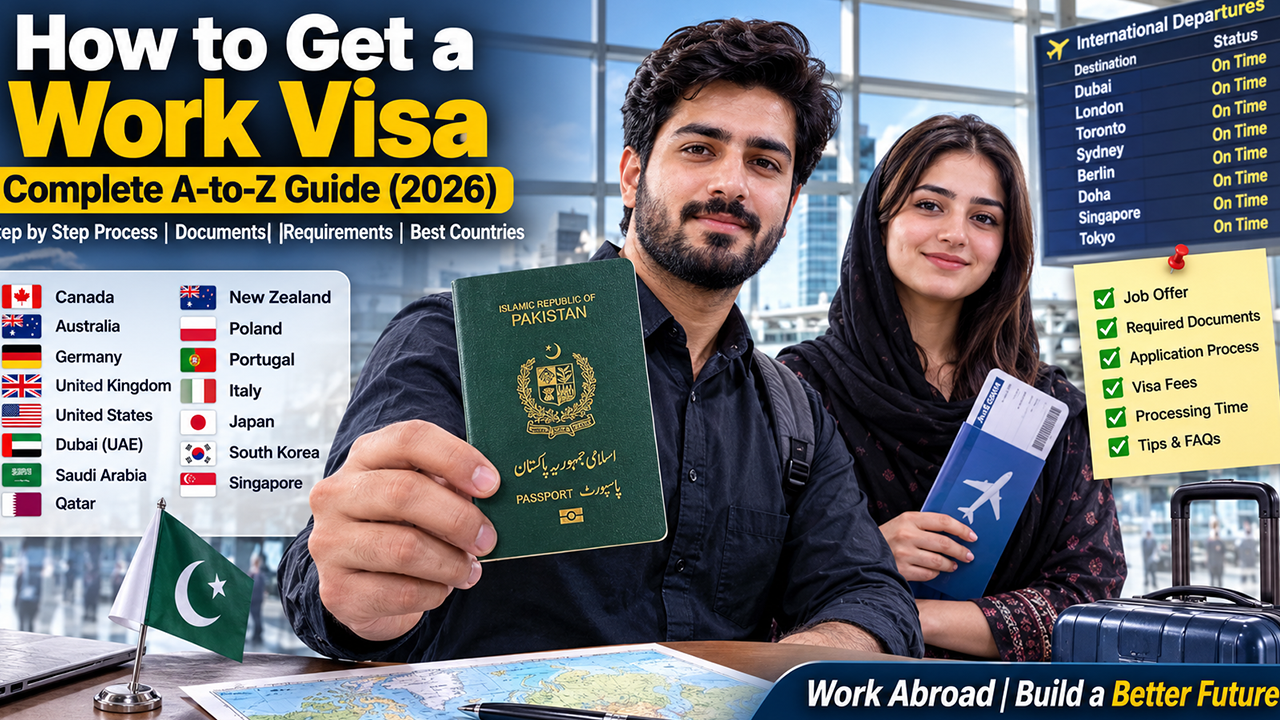
Among the most popular destinations are:
Canada
Australia
Germany
United Kingdom
United States
United Arab Emirates
Saudi Arabia
Qatar
New Zealand
Portugal
Poland
Italy
Japan
South Korea
Singapore
Each country has its own visa rules, salary levels, and eligibility requirements, which will be explained in the next part of this guide.
Common Mistakes to Avoid
Many applications are delayed or rejected because of avoidable mistakes, including:
Submitting incomplete documents
Using fake experience certificates
Applying through unverified agents
Providing incorrect information
Ignoring visa instructions
Missing deadlines
Applying for jobs that do not match your qualifications
Being honest and carefully preparing your application significantly improves your chances of success.
1. Canada Work Visa
Canada remains one of the most popular destinations for skilled workers because of its strong economy, high quality of life, and immigrant-friendly policies. Thousands of international workers receive work permits every year across industries such as healthcare, IT, construction, transportation, engineering, hospitality, and agriculture.
Eligibility
Valid passport
Job offer from a Canadian employer (for most work permits)
Educational qualifications
Relevant work experience
Medical examination (if required)
Police clearance certificate
IELTS Requirement
IELTS is not required for every work permit. However, it is often needed for permanent immigration pathways such as Express Entry.
Processing Time
Approximately 4 to 16 weeks, depending on the applicant’s country and visa category.
Average Salary
Most skilled workers earn between CAD 45,000 and CAD 90,000 per year, depending on their profession.
Official Website
https://www.canada.ca
2. Australia Work Visa
Australia has a high demand for skilled workers in healthcare, engineering, IT, education, construction, mining, and hospitality.
The country regularly updates its Skilled Occupation List based on labour shortages.
Eligibility
Passport
Relevant educational qualification
Work experience
English language proficiency
Skills assessment (for many occupations)
IELTS Requirement
Usually required for skilled migration visas.
Some employers may accept equivalent English tests.
Age Limit
Most skilled visa programs prefer applicants under 45 years.
Processing Time
Approximately 2 to 8 months depending on the visa category.
Average Salary
Most professionals earn between AUD 70,000 and AUD 120,000 annually.
Official Website
https://immi.homeaffairs.gov.au
3. Germany Work Visa
Germany continues to face shortages of skilled professionals, particularly in engineering, nursing, manufacturing, logistics, and information technology.
Its modern economy offers excellent opportunities for qualified foreign workers.
Eligibility
Recognized educational qualification
Employment contract
Valid passport
Health insurance
Financial support (if required)
German Language
Some jobs require German language skills, although many IT and engineering positions operate in English.
Processing Time
Generally 6 to 12 weeks.
Average Salary
Most skilled employees earn between €40,000 and €70,000 annually.
Official Website
https://www.make-it-in-germany.com
4. United Kingdom Skilled Worker Visa
The UK remains one of the world’s leading destinations for professionals in healthcare, finance, technology, engineering, and education.
Its Skilled Worker Visa allows employers to recruit qualified international workers when suitable local candidates are unavailable.
Eligibility
Job offer from a licensed sponsor
Certificate of Sponsorship
Valid passport
Required salary level
English language ability
IELTS Requirement
English language proof is generally required.
Processing Time
Usually around 3 to 8 weeks.
Average Salary
Skilled professionals commonly earn £30,000 to £60,000 per year, with higher salaries in specialist fields.
Official Website
https://www.gov.uk
5. United States Work Visa
The United States offers various work visas depending on profession and employment category.
Technology, healthcare, finance, engineering, and research remain among the strongest employment sectors.
Common Work Visas
H-1B (Specialty Occupations)
L-1 (Company Transfers)
O Visa (Exceptional Talent)
Eligibility
Job offer
Employer sponsorship
Educational qualification
Relevant experience
English Test
No general IELTS requirement for most employment visas.
Processing Time
Ranges from 2 to 8 months, depending on the visa category.
Average Salary
Many professionals earn USD 60,000 to USD 120,000 annually, although salaries vary widely by industry and state.
Official Website
https://travel.state.gov
6. United Arab Emirates (UAE)
Dubai and Abu Dhabi continue attracting professionals from around the world.
Unlike many Western countries, employers usually handle much of the visa process after hiring a foreign worker.
Popular Jobs
Hospitality
Construction
Aviation
Healthcare
Retail
Information Technology
Finance
Eligibility
Passport
Employment contract
Medical examination
Emirates ID registration after arrival
IELTS Requirement
Not generally required.
Processing Time
Normally 2 to 6 weeks.
Average Salary
Monthly salaries vary significantly:
Entry level: AED 3,500–6,000
Skilled professionals: AED 8,000–25,000+
Official Website
https://u.ae
Best Jobs in High Demand (2026)
Many countries currently face shortages in these professions:
Software Developers
Nurses
Doctors
Caregivers
Civil Engineers
Electricians
Welders
Truck Drivers
Plumbers
Teachers
Accountants
Data Analysts
Cybersecurity Specialists
AI Engineers
Construction Workers
Hospitality Staff
Agricultural Workers
If your profession appears on a country’s shortage occupation list, your chances of finding employment are often higher.
How Much Money Do You Need?
Costs vary depending on the destination.
Typical expenses include:
Passport
Medical examination
Police clearance
Visa fee
Document translation
Biometrics
Air ticket
Initial accommodation
Many employers, especially in Gulf countries, may cover part of these costs.
Can You Take Your Family?
Several countries allow eligible workers to bring close family members.
Depending on the visa program, spouses may receive permission to work, while children can often attend local schools.
Always check the specific family sponsorship rules before applying.
How Long Does It Take?
Average processing times vary:
Canada: 4–16 weeks
Australia: 2–8 months
Germany: 6–12 weeks
UK: 3–8 weeks
USA: 2–8 months
UAE: 2–6 weeks
Actual timelines depend on document verification, application volume, and individual circumstances.
7. Saudi Arabia Work Visa
Saudi Arabia continues to recruit foreign professionals across healthcare, engineering, construction, hospitality, logistics, and oil and gas sectors.
Eligibility
Valid passport
Confirmed job offer
Employment contract
Medical examination
Police clearance (if required)
IELTS Requirement
Not required for most jobs.
Processing Time
Usually 2–6 weeks.
Average Salary
SAR 4,000–15,000+ per month depending on profession.
Official Website
https://www.my.gov.sa
8. Qatar Work Visa
Qatar remains a popular destination because of tax-free salaries and demand in construction, healthcare, education, hospitality, and engineering.
Eligibility
Job offer
Passport
Medical fitness
Employer sponsorship
IELTS
Not mandatory for most professions.
Processing Time
Approximately 2–5 weeks.
Average Salary
QAR 4,000–18,000+ per month.
Official Website
https://hukoomi.gov.qa
9. New Zealand Work Visa
New Zealand welcomes skilled workers in healthcare, IT, construction, agriculture, education, and engineering.
Requirements
Valid passport
Job offer (for many visas)
Relevant qualifications
Work experience
English language ability (depending on visa)
Processing Time
Around 1–4 months.
Average Salary
NZD 55,000–90,000 annually.
Official Website
https://www.immigration.govt.nz
10. Poland Work Visa
Poland has become an attractive destination for factory workers, warehouse staff, drivers, construction workers, and skilled professionals.
Eligibility
Job contract
Passport
Medical insurance
Visa application
IELTS
Usually not required.
Processing Time
4–8 weeks.
Average Salary
PLN 5,000–10,000 per month depending on industry.
Official Website
https://www.gov.pl
11. Portugal Work Visa
Portugal offers growing opportunities in tourism, hospitality, IT, healthcare, and skilled trades.
Requirements
Job offer
Passport
Financial documents
Health insurance
Processing Time
Approximately 2–3 months.
Official Website
https://vistos.mne.gov.pt
12. Italy Work Visa
Italy opens seasonal and non-seasonal work visa programs based on labor shortages.
Popular sectors include:
Agriculture
Hospitality
Tourism
Manufacturing
Construction
Processing normally takes 1–3 months.
Official Website:
https://vistoperitalia.esteri.it
13. Japan Work Visa
Japan faces worker shortages because of its aging population.
Demand exists for:
Engineers
Nurses
Caregivers
IT Professionals
Manufacturing Workers
Requirements
Job offer
Passport
Educational qualification
Certificate of Eligibility
Processing generally takes 1–3 months.
Official Website:
https://www.mofa.go.jp
14. South Korea Work Visa
South Korea recruits international workers in manufacturing, technology, engineering, education, and research.
Processing Time
Usually 1–2 months.
Official Website
https://www.visa.go.kr
15. Singapore Work Visa
Singapore offers excellent opportunities in finance, IT, healthcare, engineering, logistics, and business management.
Requirements
Job offer
Employer sponsorship
Educational qualification
Average Salary
SGD 3,500–10,000+ monthly.
Official Website
https://www.mom.gov.sg
Common Reasons Why Work Visas Are Rejected
Many applications are refused because applicants make avoidable mistakes.
The most common reasons include:
Fake educational documents
False work experience
Incomplete application forms
Invalid passport
Criminal record
Failed medical examination
Insufficient financial evidence (where required)
Incorrect information
Applying through unauthorized agents
Always provide truthful and complete information.
How to Avoid Immigration Scams
Unfortunately, thousands of people lose money every year to fake visa agents.
To stay safe:
✔ Never pay someone who guarantees visa approval.
✔ Always verify job offers directly with the employer.
✔ Use only official government immigration websites.
✔ Never submit fake documents.
✔ Avoid agents asking for unusually high upfront fees.
✔ Keep copies of every document you submit.
If an offer sounds too good to be true, it probably is.
Tips to Increase Your Chances of Approval
Build a professional CV.
Improve your English skills.
Gain relevant work experience.
Apply only for jobs matching your qualifications.
Double-check all documents.
Follow official instructions carefully.
Submit applications before deadlines.
Keep digital and printed copies of all records.
Preparation significantly improves your chances of success.
Frequently Asked Questions
Which country offers the easiest work visa?
It depends on your profession and qualifications. Countries experiencing labor shortages often have more opportunities for eligible applicants.
Can I apply without a job offer?
Some immigration pathways allow applications without a job offer, but many employer-sponsored work visas require one.
Is IELTS compulsory?
No. It depends on the country and the visa category.
Can my family come with me?
Many countries allow eligible workers to sponsor their spouse and children, subject to visa rules.
Can a work visa lead to permanent residence?
In several countries, long-term employment may create opportunities to apply for permanent residence if all legal requirements are met.
Final Thoughts
Obtaining a work visa is not simply about filling out an application. It requires careful planning, accurate documentation, and a clear understanding of each country’s immigration rules. Every destination has different eligibility requirements, processing times, and employment opportunities, so researching official information before applying is essential.
Whether you plan to work in Canada, Australia, Germany, the UK, the UAE, Japan, or another country, the best approach is to build strong qualifications, apply through legitimate employers, and rely only on official government immigration websites. Avoid shortcuts, stay informed, and prepare your application carefully.
With patience, the right skills, and a well-prepared application, working abroad can become a realistic goal that opens the door to valuable international experience and long-term career growth.