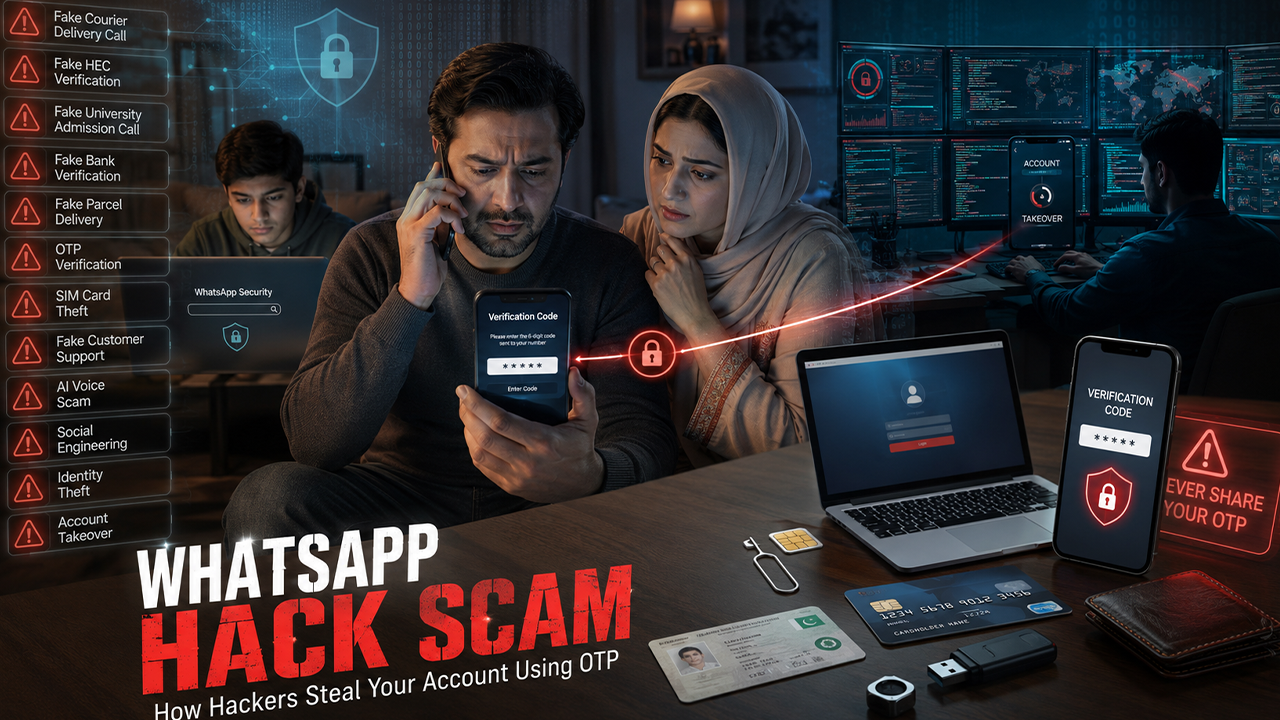
Imagine waking up one morning only to discover that you can no longer access your WhatsApp account. Friends begin calling to ask why you’re requesting money, family members receive suspicious messages from your number, and your personal chats, photos, and contacts are no longer under your control.
This isn’t a movie plot—it’s happening to thousands of people every day.
Cybercriminals no longer need sophisticated hacking tools to take over your WhatsApp account. In many cases, they don’t hack your phone—they trick you into handing over access yourself. A simple phone call, a fake delivery notification, a convincing university representative, or even a misplaced SIM card can be enough for criminals to seize control of your digital identity within minutes.
What makes these attacks even more dangerous is that most victims never realize they’re being scammed until it’s too late. The attackers sound professional, speak confidently, and create a sense of urgency that pressures people into making quick decisions.
In this article, we’ll uncover the most common ways WhatsApp accounts are compromised today, explain why these scams work so effectively, and reveal the growing techniques cybercriminals are using to bypass traditional security measures.
Why WhatsApp Has Become a Prime Target
WhatsApp has become far more than just a messaging app. For millions of people, it stores:
Personal conversations
Business communications
Family photographs
Financial discussions
Banking alerts
Two-factor authentication codes
Important documents
Customer information
Once attackers gain control of a WhatsApp account, they often use it to impersonate the victim, target friends and family, spread scams, or attempt financial fraud.
The OTP Scam: The Most Common Way WhatsApp Gets Stolen
The majority of WhatsApp hijackings today begin with a One-Time Password (OTP).
WhatsApp uses OTP verification whenever someone attempts to register an account on a new device. If an attacker starts the registration process using your phone number, WhatsApp sends a verification code to your number.
The criminal’s only challenge is convincing you to reveal that code.
Rather than breaking into your phone, they manipulate you into giving them the key.
Fake Courier Delivery Calls
One of the fastest-growing scams involves fake delivery agents.
You may receive a phone call claiming:
“Sir, your parcel has arrived.”
The caller sounds polite and professional.
They may know your name or city, making the conversation seem genuine.
After a few moments they say:
“A verification code has just been sent to your mobile. Please tell us the code so we can complete your delivery.”
Many people believe the request is legitimate.
The moment the victim shares the verification code, the attacker registers the victim’s WhatsApp account on another device.
Within minutes, the original user is logged out.
Fake University and HEC Verification Calls
Students have become a major target.
Attackers pretend to represent:
Higher Education Commission (HEC)
Universities
Scholarship departments
Admission offices
Examination boards
The caller may say:
“Your documents have been approved.”
or
“Your degree verification is pending.”
or
“We need one verification code before dispatching your documents.”
Victims who trust the caller unknowingly reveal their WhatsApp verification code.
Fake Government Department Calls
Cybercriminals frequently impersonate government offices.
Examples include:
NADRA
Passport Office
Excise Department
Tax authorities
Utility companies
The caller claims your application requires verification and requests the code sent to your phone.
The victim believes they are completing an official process.
Instead, they are handing over access to their WhatsApp account.
Fake Bank Verification Scams
Another common tactic involves fake banking representatives.
The scammer claims:
Your account has suspicious activity.
Your ATM card is being blocked.
Your account requires verification.
A payment failed.
The victim receives an OTP and assumes it belongs to the bank.
In reality, the code is often generated by another service—or, in WhatsApp takeover scams, it is the WhatsApp verification code itself.
SIM Card Theft: The Silent Attack Most People Ignore
Many people believe:
“My phone is locked, so nobody can access my information.”
Unfortunately, this creates a false sense of security.
Even if your phone is protected with a PIN, fingerprint, or Face ID, the SIM card can usually be removed in seconds.
If someone gains physical access to your phone, they may remove the SIM and insert it into another device.
Once the SIM is active in their phone, they can receive verification messages and OTPs sent to your number.
That includes WhatsApp verification codes and, in some cases, codes used by banks or other online services.
Leaving Your Phone Unattended
A surprisingly common mistake is leaving a phone unattended in public or semi-public places.
Examples include:
Charging stations
Office desks
University classrooms
Restaurants
Waiting areas
Friends’ houses
Family gatherings
Many people assume:
“My phone is locked, so it’s safe.”
However, someone only needs brief physical access to remove the SIM card or gather enough information to launch further attacks.
Mobile Repair Shop Risks
When people hand over their phones for repairs, they often leave the SIM card inside the device.
Most technicians are trustworthy—but criminals have abused this situation in some reported cases.
If a dishonest individual gains temporary access to the SIM, they may attempt account registration or collect sensitive verification codes.
Removing the SIM before submitting a phone for repair is a simple precaution many people overlook.
Social Engineering: The Real Weapon
The biggest weapon cybercriminals use isn’t malware.
It’s psychology.
They create urgency by saying:
“Your parcel will be returned.”
“Your admission will be cancelled.”
“Your bank account is under threat.”
“Your documents cannot be delivered.”
“Immediate verification is required.”
When people panic, they stop thinking critically.
That emotional pressure is exactly what attackers rely on.
Fake Job Opportunities
Job seekers are increasingly targeted through fake recruitment calls.
Victims are told:
Their application has been shortlisted.
An interview has been scheduled.
Employment documents need verification.
A verification code is requested during the process.
Many victims assume it’s part of the recruitment procedure.
QR Code Scams
QR codes are becoming another popular attack method.
Fraudsters send QR codes claiming they are for:
Payment confirmation
Prize collection
Delivery tracking
Event registration
Customer support
Scanning a malicious QR code may redirect users to fake login pages designed to steal credentials or initiate fraudulent actions.
Fake WhatsApp Support
Some criminals impersonate WhatsApp support staff.
They contact users through calls, messages, or fake websites claiming:
Your account has violated policies.
Your account will be suspended.
Verification is required.
Victims are instructed to share codes or click malicious links.
AI Voice Scams
Artificial Intelligence has introduced an even more alarming threat.
Scammers can now generate highly realistic voices that imitate:
Family members
Friends
Employers
Government officials
Victims may receive calls that sound authentic, making it much easier for attackers to gain trust.
Why Victims Keep Falling for These Scams
Most victims aren’t careless.
They simply trust the wrong person at the wrong moment.
Attackers exploit:
Fear
Urgency
Authority
Trust
Curiosity
The technology is sophisticated, but the attack itself often relies on human psychology rather than technical hacking.
Conclusion
Today’s cybercriminals rarely need to break into your phone using advanced hacking tools. Instead, they rely on deception, fake identities, stolen SIM cards, convincing phone calls, and psychological manipulation to gain access to your WhatsApp account. Whether it’s a fake courier asking for an OTP, someone pretending to represent a university or government department, or a criminal exploiting temporary access to your SIM card, the result can be the same—your digital identity falls into the wrong hands.
Understanding how these attacks happen is the first step toward protecting yourself. In the next article, we’ll explore the practical steps you can take to secure your WhatsApp account, protect your SIM card, strengthen your online security, and defend yourself against these increasingly sophisticated scams before they become someone else’s success story.