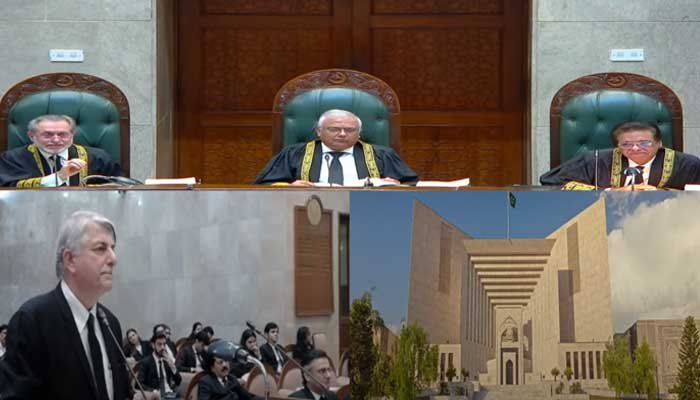
ISLAMABAD: Supreme Court Justice Muhammad Ali Mazhar on Monday reaffirmed that constitutional matters will only be heard by the constitutional bench, not a full court, during a hearing on petitions challenging the 26th Constitutional Amendment passed by parliament in October 2024.
The seven-member bench, headed by Justice Amin-ud-Din, includes Justices Jamal Khan Mandokhail, Ayesha A Malik, Syed Hasan Azhar Rizvi, Musarrat Hilali, Naeem Akhter Afghan, and Shahid Bilal Hassan.
Justice Mazhar noted that although petitioners have requested the matter be referred to a full court, Article 191-A does not mention the term “full court,” and the chief justice no longer has the authority to form one under the amendment. “Constitutional matters will only be heard by the constitutional bench,” he stated firmly.
During the proceedings, Justice Jamal Mandokhail clarified that a full court cannot comprise selectively chosen judges, stating, “You can only request a full court.” He added that if judges appointed before the 26th Amendment are included, others would necessarily be excluded.
Advocate Abid Zuberi, representing one of the petitioners, maintained that he was not suggesting the removal of any sitting judges. When asked whether he would accept a Judicial Commission declaration that all SC judges are part of the constitutional bench, he replied, “Yes, absolutely — we would accept it.”
The Supreme Court streamed the hearing live, and the case was adjourned until Tuesday.
The 26th Constitutional Amendment, which was passed in October 2024, introduced sweeping judicial reforms including:
- Fixing the Chief Justice of Pakistan’s tenure at three years.
- Establishing constitutional benches in the Supreme Court and high courts.
- Allowing a parliamentary committee to nominate the new chief justice from the three most senior judges.
- Mandating JCP oversight of judges’ performance.
- Setting a national target for the complete eradication of Riba (interest) by January 1, 2028.
Political parties such as PTI, JI, and SIC, along with various bar associations and former SCBA presidents, have filed petitions challenging the amendment’s legality.