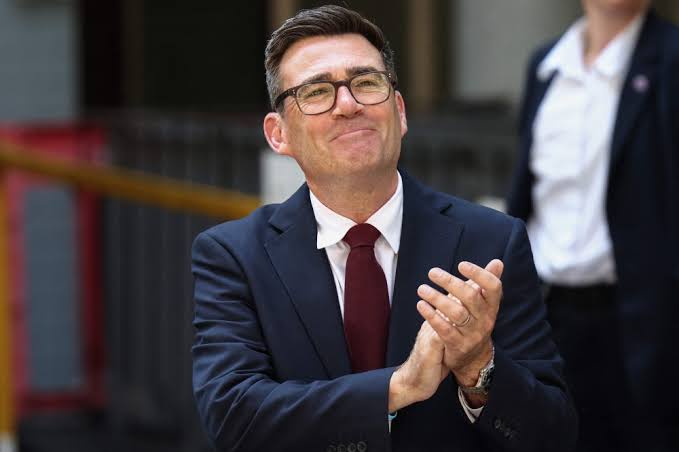
Andy Burnham Becomes UK’s Seventh Prime Minister in a Decade, Vows to “Rewire” Britain
Andy Burnham has become Britain’s seventh prime minister in just ten years, taking office on Monday with a promise to fundamentally “rewire” the nation and refocus government attention on the issues most people actually care about, chief among them the ongoing cost-of-living crisis and chronically underperforming public services.
The transition followed a familiar constitutional choreography. Outgoing Prime Minister Keir Starmer delivered his farewell address outside 10 Downing Street before formally submitting his resignation to King Charles. The monarch then received Burnham and formally asked him to form a government, completing the handover.
From “King of the North” to Downing Street
For the 56-year-old Burnham, this marks the culmination of a political journey that took him from serving as mayor of Greater Manchester, a role in which he earned the nickname “King of the North”, to the very top of British politics. But arriving at Downing Street is really just the beginning. Burnham now inherits a formidable list of challenges, ranging from underperforming utility companies to sluggish economic growth, all while navigating intense internal debate within his own Labour Party over who will fill out his cabinet.
Setting Out a New Political Direction
Burnham is expected to use his first speech as prime minister to lay out a vision for what his office described as “a more stable and responsible politics.” He plans to frame his appointment as a moment of reflection, arguing that the country needs honesty about the scale of the challenges it faces and that only sustained political stability can actually deliver improvements people will notice in their daily lives.
Reflecting on his elevation to Labour leader just days earlier, Burnham had described it as the most significant shift in British politics in four decades. He pledged to radically overhaul the political system in order to quickly raise living standards, framing his mission as making life more affordable and ensuring that people and places across the country are lifted from wherever they currently stand.
A Message Aimed Squarely at Labour’s Anxieties
That message was directed as much at his own party as at the country. Labour lawmakers have increasingly viewed Burnham as one of the few figures within the party capable of countering the growing threat posed by veteran Brexit campaigner Nigel Farage and his populist Reform UK movement, a challenge many in Labour doubted the more unpopular Starmer could effectively meet.
The Cabinet Question
Burnham’s most immediate test will be assembling his cabinet, particularly the appointment of his finance minister. History offers a cautionary lesson here: friction between a prime minister and chancellor has been enough to bring down previous governments, making this one of the most consequential early decisions any incoming leader makes.
Energy security and net zero minister Ed Miliband had initially been seen as an early frontrunner for the finance role, though he’s faced some pointed internal criticism in recent days. Interior minister Shabana Mahmood now appears to be the favourite for the position instead. For his part, Burnham urged party colleagues on Friday to disregard the swirl of speculation, insisting he had not yet finalised his top team.
Early Policy Decisions Already Under the Microscope
Even before formally taking office, Burnham’s policy instincts were already being tested. On Sunday, plans were scrapped for a mandatory digital identity scheme that would have required all employees to hold digital ID documents. The programme, originally designed to help tackle illegal migration, had been labelled a “fiasco” by a cross-party committee of lawmakers, and its cancellation offers an early signal of how Burnham intends to approach inherited policy commitments he views as unworkable.
Attention is now shifting toward his forthcoming decisions on taxation, government spending, oil and gas policy, and the fate of struggling utility companies, an area where Burnham has signalled he wants to see stronger public control exercised.
Thames Water in the Spotlight
One utility firm in particular looms large over this debate: Thames Water, Britain’s largest water company, which has been weighed down by substantial debt and has faced sustained public criticism over frequent sewage leaks. On Sunday, Deputy Labour Leader Lucy Powell, seen as a close Burnham ally, suggested the company could be placed under “special measures,” effectively bringing it under direct government control.
Speaking to Sky News, Powell explained that Burnham intends to refocus and reprioritise government resources and attention squarely on tackling the cost of living, describing his broader ambition as genuinely rewiring how the country’s economy functions at a structural level.
What Comes Next
With his cabinet still being finalised and early policy signals already generating debate, Burnham’s first weeks in office are likely to set the tone for how his government approaches the twin challenges of economic stagnation and eroding public trust in Westminster. Whether his promise to “rewire Britain” translates into tangible improvements in living standards, or simply becomes another ambitious slogan from yet another prime minister in a decade marked by political turnover, will likely become clearer as his cabinet takes shape and his government’s first substantive policy decisions begin to roll out in the weeks ahead.