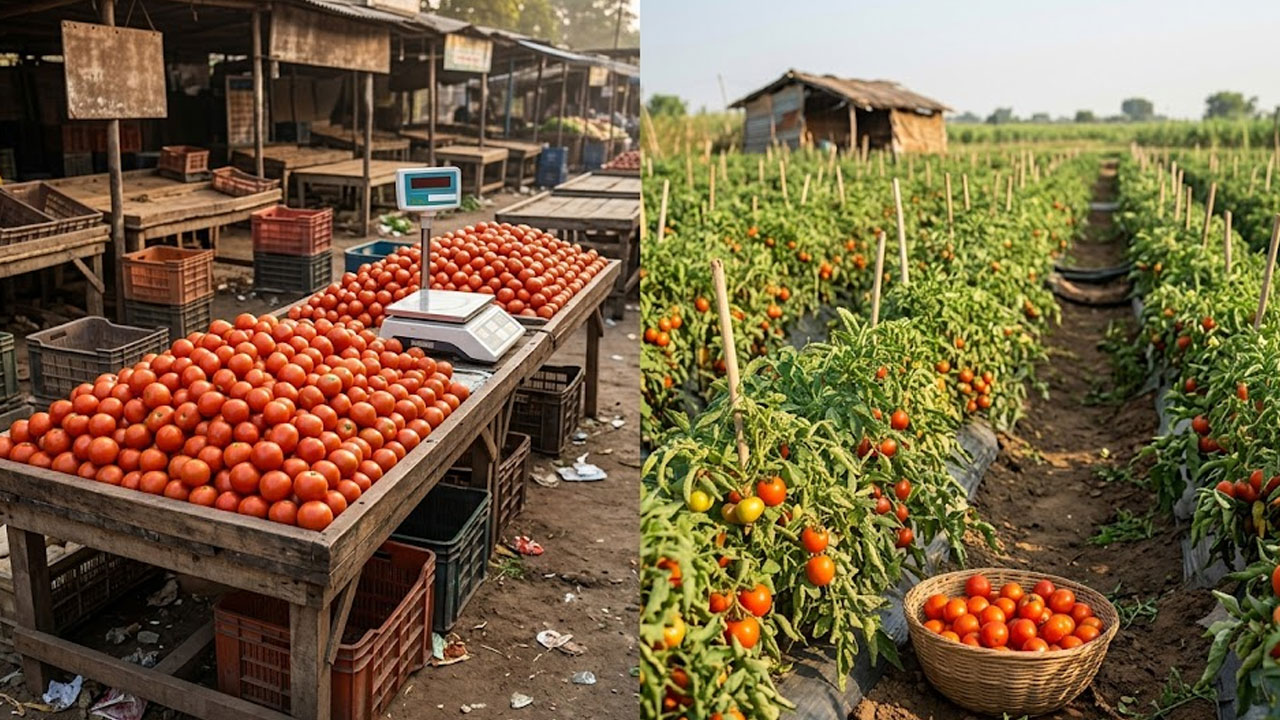
Here is a number that should bother anyone who thinks about Pakistan’s economy. When a consumer buys fruits or vegetables in a city market, the farmer who actually grew the produce typically receives only 15 to 20 percent of that retail price, according to the Asian Development Bank. The other 80-odd percent is absorbed somewhere between the field and the shelf.
At the same time, roughly 30 to 40 percent of Pakistan’s fruit and vegetable output — from a total of around 13 million tonnes a year — is lost after harvest, to spoilage, poor handling, and market gluts.
Put those two facts together and you have one of the most quietly damaging inefficiencies in the national economy: the farmer earns a fraction of the final price, and a third of the food is wasted before anyone eats it. This is not a farming problem. Our farmers grow plenty. It is a market problem — a failure of how price, information, and produce move between the grower and the buyer.
The Real Disadvantage: The Farmer Sells Blind
Strip away the complexity and the farmer’s core problem is simple: he does not know the price.
A grower in a village outside Sahiwal or Mardan has no reliable, real-time view of what his crop is fetching that morning in Lahore, Karachi, or even the next district’s mandi. He harvests, loads a truck, and sells to whoever is in front of him — often a commission agent (arhti) who has already advanced him money against the crop, and who therefore holds the stronger hand. The rate is quoted to the farmer, not discovered by him.
This is what economists call information asymmetry, and in the mandi it is the whole game. The intermediary’s advantage is not that he adds enormous value; it is that he knows the price and the farmer does not. Whoever holds the information holds the margin.
The waste flows from the same blindness. Because no one has a clear, aggregated picture of what is arriving where, produce piles into the same few markets on the same days. Prices collapse under a local glut while another city runs short. Perishables that cannot be moved in time simply rot. In the absence of a demand signal, a bumper harvest becomes a punishment — growers are forced to dump produce below the cost of picking and transporting it.
What Actually Changes the Equation
For decades the proposed fixes were physical and expensive: more cold storage, reefer trucks, new market yards. All of that is genuinely needed, and progress has been painfully slow because it costs billions.
But a cheaper lever has quietly become available — information itself.
A farmer with a smartphone can now, in principle, see live mandi rates for his crop across multiple markets, check which buyers are actively demanding what, and time his sale accordingly. This is the premise behind a new wave of Pakistani agri-platforms — services such as Kissan Market, which pull together live mandi rates, buyer demand, weather, and direct produce listings so that a grower can walk into a sale already knowing roughly what his crop is worth and who wants it.
The effect is not to abolish the arhti — that is neither realistic nor, in many cases, desirable, since agents also provide credit and logistics the formal system does not. The effect is subtler and more important: it rebalances the information. A farmer who knows the going rate negotiates from a different position. A buyer in a short market can find produce sitting in a surplus one. Price discovery — the thing a functioning market is supposed to do automatically — starts to actually happen.
Why This Is an Economic Story, Not Just an Agri One
If even a slice of that 80 percent gap and that 40 percent waste is recovered, the ripple effects reach well beyond the farm.
Rural Incomes and Demand
Agriculture employs close to 37 percent of Pakistan’s labour force. When farmers capture a few more points of the final price, that money does not disappear into a vault — it is spent in rural economies, on inputs, goods, and services. Farm gate income is domestic demand.
Food Prices and Inflation
Waste is inflationary. When a third of perishable supply is destroyed by poor market coordination, the produce that survives costs more. Reducing that loss through better matching of supply and demand eases pressure on the urban consumer as much as it helps the farmer — a rare win on both ends of the chain.
Data the Country Simply Doesn’t Have
Pakistan lacks reliable, timely data on what is being produced and traded where. Every serious value-chain study says the same thing: we are flying blind on production and prices.
Digital marketplaces, as a byproduct of doing business, generate exactly this data — a real-time picture of supply, demand, and price that could inform everything from import decisions to procurement.
The Honest Caveats
None of this is a switch that flips.
Trust is earned slowly; a farmer who has dealt with the same agent for twenty years will not move on the strength of an app.
Logistics remain a hard, physical constraint — information tells you where the better price is, but the produce still has to get there, and the cold chain is still missing.
Transparency alone does not feed anyone; it has to be paired, over time, with the storage and transport investment that platforms cannot substitute for.
The realistic near-term win is not a farmer bypassing every middleman. It is a better informed farmer — one who is harder to underpay, and a market that wastes a little less because supply and demand can finally see each other.
The Bottom Line
Pakistan does not have a problem growing food. It has a problem pricing and moving it.
The 15-percent farmer and the 40-percent waste pile are two symptoms of the same disease: a market where information does not flow.
Fixing that is far cheaper than pouring concrete, and the payoff — higher rural incomes, less waste, and real data on the country’s largest employer — is exactly the kind of quiet, compounding gain the economy needs most.
The farmer already does the hard part. The least the market can do is tell him what his work is worth.