Pakistan, China Sign Economic Research Pact
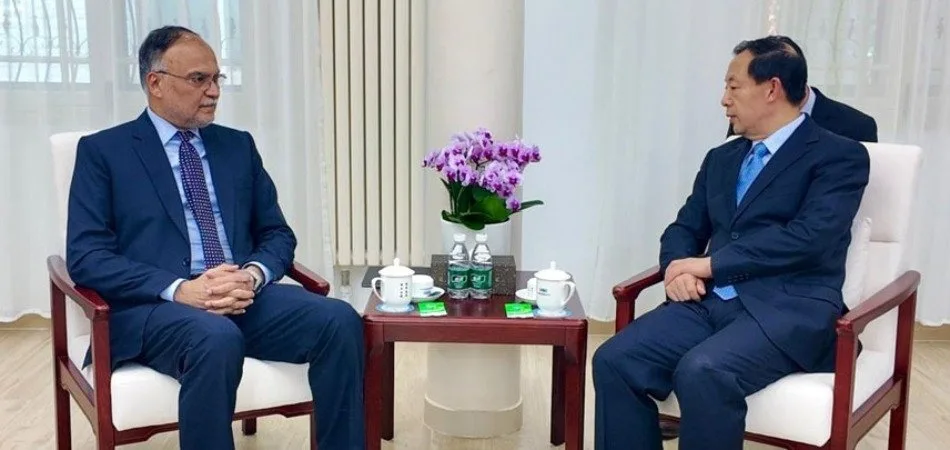
ISLAMABAD (Web Desk) – Pakistan and China have strengthened their strategic partnership with a new agreement focused on joint research, training programmes, and expert exchanges in the field of economic planning and development, according to Pakistan's state broadcaster.
The understanding was reached during a high-level meeting in Beijing between Pakistan’s Planning Minister Ahsan Iqbal and Lu Hao, President of China’s Development Research Center (DRC) and Center for International Knowledge on Development (CIKD).
Minister Iqbal emphasized Pakistan’s strong interest in learning from China’s remarkable achievements in economic planning, reforms, and sustainable development.
“China’s scientific planning is a beacon of long-term and sustainable economic development,” he said, highlighting that Islamabad is keen to replicate successful models of Chinese economic transformation to boost exports and trade.
The Development Research Center is a prestigious policy research institution directly under the Chinese central government, offering critical advice on long-term strategic planning and reforms. The new partnership is expected to enable Pakistan to deepen its economic reforms, enhance institutional capacity, and transition towards an export-oriented model.
Strategic Context:
This development comes amid China’s continued economic and military support to Pakistan. Under the China-Pakistan Economic Corridor (CPEC) framework, Beijing has already invested billions in Pakistan's energy and infrastructure sectors. China has also helped Islamabad with loan rollovers to ease external debt pressures.
The cooperation between the two nations extends beyond economics. The military partnership was visibly demonstrated during the May 2025 four-day standoff with India, during which Pakistan claimed to have downed six Indian aircraft, including three Rafale jets, using Chinese-supplied J-10C and JF-17 fighter jets, supported by HQ-9P missile systems, radar, and drones.
According to Stockholm International Peace Research Institute (SIPRI), Pakistan accounts for approximately 63% of China’s arms exports, further underlining the depth of their strategic alliance.
Upcoming Steps:
Minister Iqbal's visit and the resulting economic understanding mark a new phase of collaboration aimed at:
- Promoting economic knowledge-sharing
- Advancing institutional reforms
- Building long-term trade resilience
This partnership is expected to be formalized through structured research collaborations, training initiatives, and expert-level dialogues in the months to come.
Related stories
 Economy
Aurangzeb, Fitch Discuss Pakistan’s Credit Outlook
 Economy
DPM Orders Strict Monitoring of Supply Chains and Prices
 Economy
IMF Raises Asia Growth Forecast, Flags Risks Ahead
 Business
Ahsan Iqbal Calls for Policy Continuity for Sustainable Growth
 Economy
PM Directs Banks to Improve Housing, SME, Farm Lending
 Economy