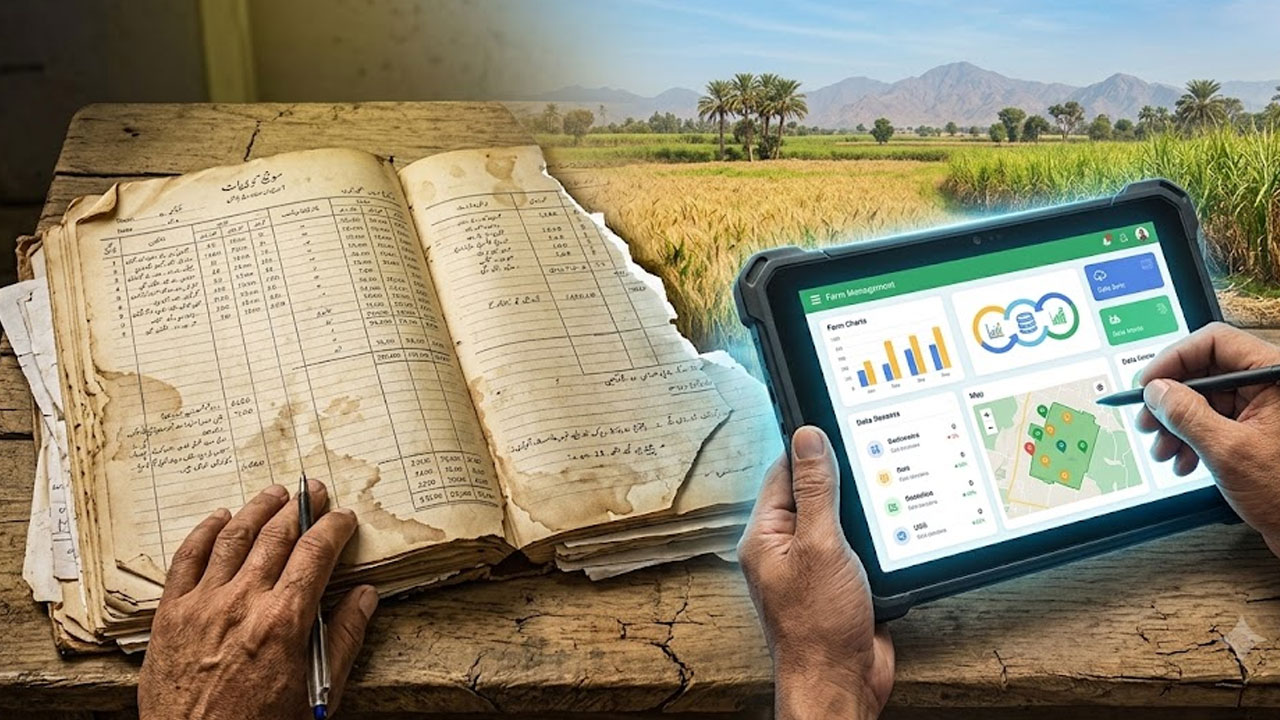
Pakistan runs on agriculture more than almost any economy its size. The sector contributes roughly 23.5% of GDP and employs close to 37% of the national labour force — a dependence that has actually deepened even as most developing economies move the other way. When we talk about Pakistan’s economy, we are, to a large degree, talking about what happens between a farmer’s field and the mandi floor.
And yet the layer where most of that money actually changes hands — the wholesale mandi, the arhti (commission agent), the daily settlement between farmer and trader — is still run almost entirely on paper. A red register, a pen, and a memory. It is one of the largest informal accounting systems in the country, and it is invisible in every official dataset.
What the Paper Register Actually Costs
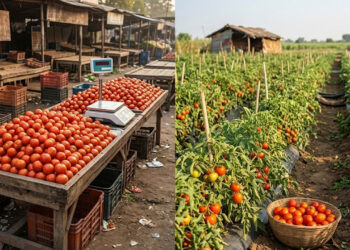
Walk into any sabzi or anaj mandi at dawn — Badami Bagh in Lahore, the Super Highway market in Karachi, Ghanta Ghar in Faisalabad — and you will see the same scene.
Trucks arrive. Produce is auctioned by open bidding (boli). An arhti sells a hundred lots before noon, deducts his commission (arhat), packaging (bardana), and weighing charges (taulai), and writes it all down by hand. The farmer waits for a handwritten parchi (slip) to know what he earned.
This system is fast, but it leaks value in ways that rarely get counted:
- Disputes and mistrust. A single forgotten advance or a miscalculated total becomes an argument between a farmer and an agent who may have done business for twenty years. Without a clear record, trust erodes on both sides.
- Vanishing receivables. A lost or damaged register means an arhti genuinely does not know how much money is owed to him. Outstanding credit (udhaar) simply disappears.
- No data, no credit. Because none of this activity is recorded formally, farmers and small traders have almost no financial history. To a bank, they are invisible — which is a large part of why rural credit in Pakistan remains so shallow.
- No visibility for anyone. Policymakers cannot see real-time price movements, spoilage, or supply gluts, because the data was never captured in the first place.
For a sector this central to the economy, that is an extraordinary blind spot.
The Quiet Shift Underway
What is changing is not policy from the top. It is tools reaching the bottom.
Three things have quietly aligned. Smartphones are now cheap and everywhere, including in rural markets. Mobile data costs have collapsed. And — crucially — a new generation of business software is being built in Urdu and Roman Urdu, for people who never used an English accounting app and never will.
The result is the early emergence of “digital khata” software built specifically for the mandi, rather than generic ledger apps bolted onto a farm workflow. These tools understand that a vegetable rate can swing 30–50% in a single morning, that produce moves in peti and jaali rather than neat units, and that a farmer needs his parchi before the truck leaves.
Pakistani entrants such as Pakka Khata — which lets an arhti book a boli sale in seconds and even query his own ledger in plain Roman Urdu (“Rahim ka kitna baqi hai?”) — are examples of software designed around the mandi’s real tempo instead of a Western small-business template.
The point is not any single app. The point is that, for the first time, the informal engine room of Pakistan’s largest employer is becoming digital-native.
Why This Matters Beyond the Mandi
If even a fraction of mandi trade moves off paper, the economic implications are larger than they first appear.
The most important is formalisation through data.
When a farmer’s sales and a trader’s receivables are recorded digitally over a season, they stop being invisible. That record is the raw material for something Pakistan has struggled to deliver for decades: rural financial inclusion.
A verifiable transaction history is what turns an unbankable farmer into a creditworthy one — the foundation for input financing, crop loans, and insurance priced on real data rather than guesswork.
There is also a transparency dividend.
A digital parchi that clearly breaks down gross sale, commission, and deductions does something a paper slip cannot: it lets the farmer see exactly how his payout was calculated. In a relationship historically shadowed by suspicion, that clarity is quietly powerful.
And for the state, aggregated (anonymised) mandi data would finally offer a real-time window into food prices and supply — the kind of signal that could inform everything from inflation management to import decisions.
The Realistic Caveats
None of this is inevitable, and it would be dishonest to pretend otherwise.
Adoption is hard. Many arhtis have run their books the same way for a generation and see no reason to change. Digital literacy among older traders is genuinely low. Trust in software holding sensitive financial data has to be earned, not assumed.
And any tool that is even slightly slower than a pen during the morning rush will simply be abandoned.
The winners in this space will not be whoever has the most features. They will be whoever makes the switch feel effortless, keeps it in the language of the mandi, and proves — one settled account at a time — that the digital record is more reliable than the register.
The Bottom Line
Pakistan spends a great deal of energy debating how to modernise its agriculture — better seeds, mechanisation, precision farming. All of that matters.
But there is a less glamorous prize sitting in plain sight: the trade and accounting layer that moves the money.
Digitising the humble mandi khata will not make headlines the way a new export corridor does. It may, quietly, do more for rural incomes, financial inclusion, and economic visibility than most policies that do.
The register served the mandi for a century. The next decade will decide how much longer it holds.