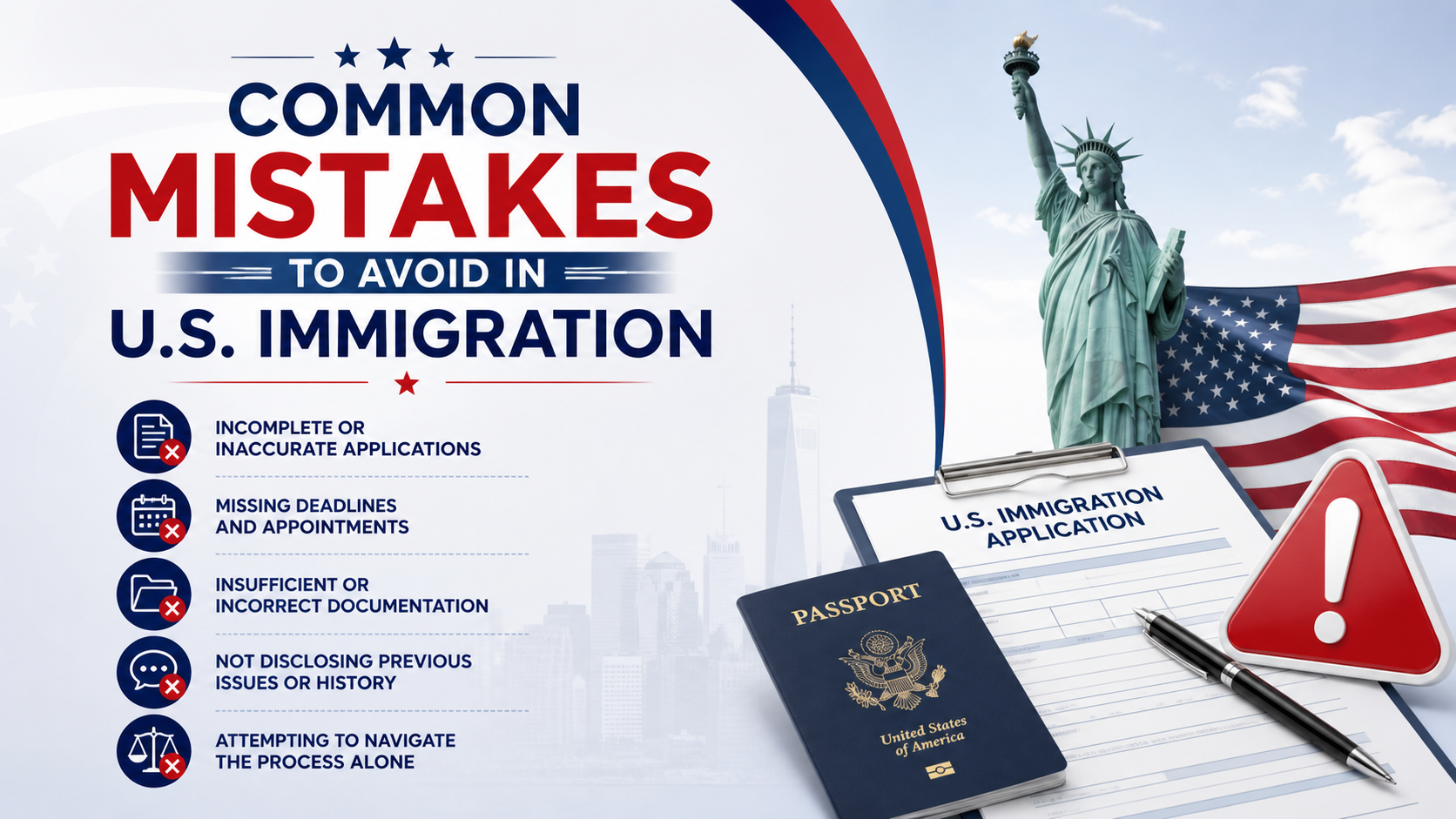
The process of moving to the United States can be overwhelming, especially if you are unfamiliar with immigration rules. Understanding the most common US immigration mistakes to avoid is essential to ensure your application is successful. Even small errors such as missing documents or incorrect information, can lead to delays, denials, or serious legal consequences. In this guide, we break down the biggest mistakes and how you can avoid them.
The process of immigrating to the United States can be very complex. Even seemingly small mistakes can have serious consequences: applications may be denied, processes delayed, or in the worst-case scenario, deportation may occur. Inaccuracies in visa forms, submitting incomplete documentation, or giving inconsistent statements during interviews can jeopardize your immigration status.
Missing deadlines set by the USCIS (United States Citizenship and Immigration Services) can significantly affect visa extensions or Green Card applications.
Incorrect or misleading information in applications—as well as missing or insufficient evidence—can raise concerns when dealing with immigration officials.
Seeking the help of an experienced immigration lawyer provides legal certainty and minimizes risks, giving you a knowledgeable partner by your side.
Now, let’s take a closer look at how you can avoid these common mistakes through consistent attention and what you can actively do to ensure your application process runs as smoothly as possible.
Introduction
The process of legally immigrating to the United States, whether through a visa, Green Card, or other pathways—is highly demanding. Every step, from choosing the right visa to properly submitting applications, attending interviews, and managing documentation, must be handled with great care.
Anyone who fills out a form incorrectly, misses a deadline, or ignores USCIS instructions may face serious difficulties.
The possible consequences range from unnecessary delays and costly requests for additional evidence to outright application denial or even deportation. Therefore, it is essential that applicants act carefully, plan thoroughly, and complete all required steps precisely.
Here, we present the most common mistakes immigrants make in the U.S.—so you can be better prepared and successfully achieve your goal.
Common Mistakes in the U.S. Immigration Process
Mistakes in your case can have far-reaching negative effects on your immigration status. What may seem like a small form error to you can be enough for USCIS to deny or delay your application. Because the system is highly complex, many applicants seek professional assistance, usually from an immigration lawyer.
Those who stay informed and understand common risks can actively avoid them and significantly improve their chances of success.
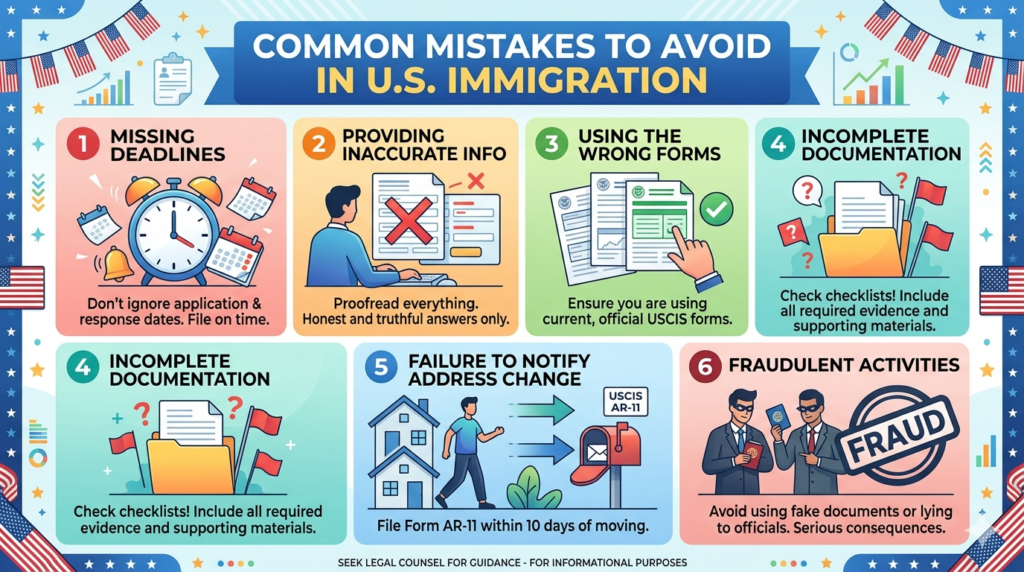
1. Submitting Incorrect or Incomplete Forms
One of the biggest US immigration mistakes to avoid is submitting forms with missing or incorrect information. Even small issues like wrong dates or missing signatures can result in rejection.
Tip: Always double-check your forms and review them with a professional if possible.
Why is this so serious?
USCIS strictly reviews forms according to its guidelines. Even minor deviations can lead to formal rejection.
- For multiple-choice questions, no field should be left blank, even selecting “N/A” requires a decision.
- Entries such as income, previous stays, or family information must be complete and accurate.
How to avoid mistakes:
- Gather all required documents before starting: passport copies, birth certificates, insurance proof, employment contracts, etc.
- Double-check everything: review once, then review again separately, ideally with a second person.
- Carefully read and understand the instructions for each form.
- If unsure, have a lawyer review the form before submission.
Practical example:
An applicant entered their birthdate in DD/MM/YYYY instead of MM/DD/YYYY- resulting in full rejection.
A missing signature on Form I-765 led to months of delay in obtaining an Employment Authorization Document (EAD).
2. Missing Important Deadlines
Every step has deadlines—for filing applications, responding to RFEs (Requests for Evidence), visa extensions, interviews, or status changes. Missing these deadlines can result in USCIS denying your case without notice or invalidating your visa. Failing to meet deadlines is another major US immigration mistake to avoid. Immigration authorities are strict, and missing a deadline can lead to denial or loss of status.
Tip: Use a calendar with reminders to track all important dates.
Consequences of missed deadlines:
- Application denial with limited chances to reapply
- Removal from the system, requiring you to start over
- Loss of legal status, possibly leading to legal consequences or forced departure
How to stay on track:
- Record all deadlines in a calendar with reminders (e.g., two weeks and five days before due dates)
- Keep copies of all submissions with timestamps
- Understand the process and allow buffer time
- Ensure documents are submitted on time, whether by mail or online
Example:
A student visa extension (F-1) was due June 15. The application was submitted on June 14, but contained a minor error. Since it wasn’t corrected in time, the application was denied despite being submitted before the deadline.
3. Failing to Provide Proper Supporting Documents
USCIS requires supporting evidence for almost every application, depending on your case: family relationships, financial stability, employment eligibility, health records, or criminal background checks. Incomplete documentation is one of the most common US immigration mistakes to avoid. Missing translations or unclear copies can delay your case.
Tip: Prepare a checklist of required documents before submission.
Common errors:
- Submitting partial or unclear documents instead of full copies
- Missing certified translations for non-English documents
- Lack of essential proof or inconsistent documentation
How to ensure completeness:
- Create a detailed checklist specific to your application type
- Gather originals and certified copies
- Use professionals (e.g., notaries) where needed
- Double-check using a checklist
- If possible, have a lawyer review your documents
4. Not Responding Properly to RFEs
An RFE (Request for Evidence) is issued when USCIS needs additional proof. This often happens if submitted documents are incomplete or unclear. Not responding properly to an RFE is a serious US immigration mistake to avoid. This can lead to automatic denial.
Tip: Respond quickly and include all requested documents clearly.
Possible consequences:
- Application denial or delay
- Filing fees are not refunded; reapplying is costly
- Delays of weeks or months; visa may expire in the meantime
How to respond correctly:
- Act immediately, RFEs include strict deadlines
- Gather official, credible documentation
- Address each point clearly and systematically
- Have your response reviewed by a professional
- Send it with proof of delivery or submit it properly online
Example:
In a National Interest Waiver (NIW) case, an applicant described a prestigious project but provided no contracts, timelines, or CVs. USCIS found the response insufficient and denied the case.
5. Overstaying or Violating Visa Conditions
Once in the U.S., maintaining your legal status is critical. Overstaying your visa or violating its terms can lead to serious consequences, including deportation. Overstaying your visa is one of the most critical US immigration mistakes to avoid, as it can result in bans or deportation.
Tip: Track your visa expiration date and apply for extensions early.
Common causes:
- Miscalculating stay duration (e.g., B-1/B-2 visas)
- Failing to extend a student visa
- Working without proper authorization
- Unauthorized employment under F-1 or J-1 status
How to stay compliant:
- Track your visa expiration date and apply for extensions 90–120 days in advance
- Work only with your authorized employer
- Maintain enrollment (for students via SEVIS)
- Plan travel carefully to avoid reentry bans (3- or 10-year bans may apply)
Example:
An F-1 student began working after graduation without extending their status. They lost legal status and had to leave the U.S., later reapplying from their home country.
6. Providing Incorrect or Misleading Information
Whether intentional or accidental, incorrect information is considered “misrepresentation.” USCIS conducts strict checks, and this can lead to denial or even a permanent entry ban. Misrepresentation, even accidental is a severe US immigration mistake to avoid that can result in permanent bans.
Tip: Always ensure your information matches official records.
Warning signs:
- Inconsistencies with previous statements
- Unexplained gaps in employment or education history
- Conflicting employer information
How to avoid misrepresentation:
- Verify all data against official documents
- Double-check with professionals
- Maintain accurate records (I-20, DS-160, DS-260, etc.)
- Be transparent about uncertainties
Example:
An applicant reported working 40 hours per week instead of 20. USCIS identified the inconsistency and denied the application due to credibility concerns.
7. Failing to Update Your Address (Form AR-11)
If you move, you are legally required to inform USCIS of your new address. Failure to do so can result in missing important notices like interviews, RFEs, or decisions. Failing to update your address is another overlooked US immigration mistake to avoid. Missing official notices can harm your case.
Tip: Update your address immediately after moving.
What to do:
- File Form AR-11 online within 10 days of moving
- Use your USCIS online account
- Keep confirmation records
- Inform your lawyer immediately
Example:
An applicant moved in April but updated their address in August. They missed an interview notice sent to the old address. USCIS treated this as a no-show and denied the application.
The path to legal immigration in the United States requires precision and diligence. Every step—applications, deadlines, documentation, RFEs, truthful responses, and address updates, must be handled carefully. Mistakes can lead to delays, denials, or legal complications.
Seeking professional help from qualified advisors, NGOs, or experienced immigration attorneys can significantly strengthen your case and ensure it is complete and legally sound.
Frequently Asked Questions (FAQ)
What should I do if I discover a mistake in my already submitted application?
Contact USCIS immediately using your receipt number. In some cases, you can submit a correction request. An attorney can assist you or act on your behalf with a Power of Attorney (POA).
Does a dismissed criminal case affect my immigration chances?
Yes. USCIS records all charges. Depending on the severity, it may impact your case or lead to further inquiries. A lawyer can help provide supporting documentation.
How important is responding to an RFE on time?
Critical. A complete and timely response prevents denial:
- Typically must respond within 90 days
- Address every point
- Include full documentation
- Legal guidance is highly recommended
Do I need a lawyer for my U.S. immigration application?
Not mandatory, but highly recommended. A lawyer understands the complexities and reduces risks significantly—especially for work visas, Green Cards, or naturalization cases.