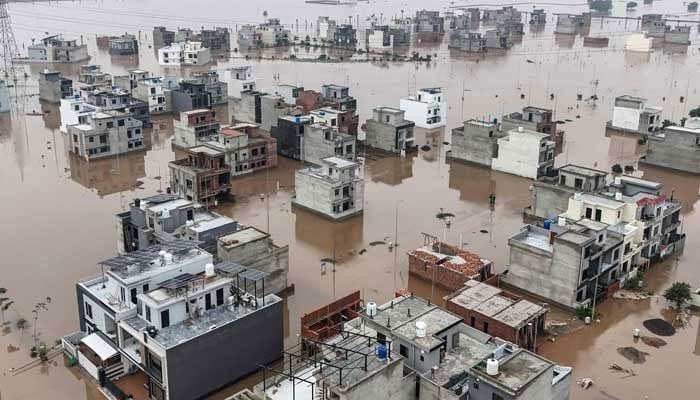
The Ministry of Finance has submitted an initial flood damage assessment report to the International Monetary Fund (IMF), revealing that the recent floods have inflicted an estimated Rs744 billion loss on Pakistan’s national economy. The unprecedented disaster has devastated livelihoods, infrastructure, and key economic sectors across 70 districts, making it one of the most destructive floods in recent years.
According to the report, 1,037 people have died and 1,067 others injured, while more than 6.5 million people have been directly affected. Around four million individuals were displaced and relocated to safer areas as part of emergency evacuation efforts.
Punjab Suffers the Most
Punjab emerged as the hardest-hit province, sustaining losses of Rs632 billion, followed by Khyber Pakhtunkhwa (Rs51 billion), Sindh (Rs32 billion), and Balochistan (Rs7 billion). Khyber Pakhtunkhwa reported the highest human toll with 509 deaths, while Punjab followed with 322 fatalities.
Agriculture Takes the Heaviest Hit
The agriculture sector bore the brunt of the calamity, accounting for Rs439 billion in damages. The industrial sector suffered losses of Rs48 billion, and the services sector faced damages worth Rs257 billion. Additional losses include Rs55 billion in real estate and Rs40 billion in the commercial sector.
Agricultural production growth is now expected to slow to 3%, compared to the earlier target of 4.5%. Cotton output has plummeted by 33%, while rice, maize, and sugarcane yields are expected to fall sharply. The floods also caused the deaths of 5,467 livestock, deepening rural economic distress.
Infrastructure and Public Services Crippled
The floods destroyed 2,811 km of roads, 790 bridges, and 866 water structures, severely disrupting connectivity and water systems. Additionally, 229,763 houses, 2,267 schools, 243 health centers, and 129 government buildings were damaged or destroyed.
Economic Outlook and IMF Coordination
Due to the massive damage, the Finance Ministry has revised Pakistan’s GDP growth target downward from 4.2% to 3.5% for the current fiscal year. Officials stated that the floods have severely affected agricultural and industrial output, posing a significant challenge to economic recovery.
The report shared with the IMF seeks assistance for rehabilitation and reconstruction, emphasizing the urgent need for international support to rebuild infrastructure and restore livelihoods in the worst-affected regions.