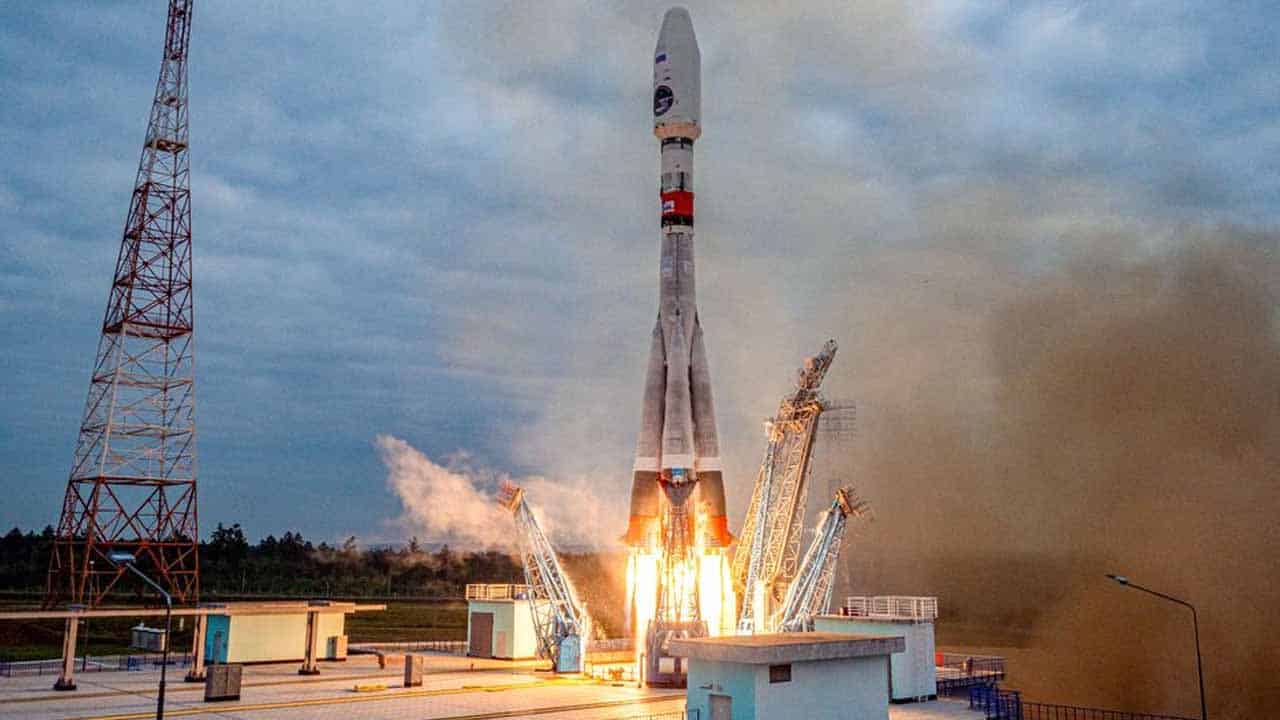
Russia launched its first moon-landing spacecraft in 47 years on Friday, aiming to be the first country to perform a soft landing on the lunar south pole, which is thought to contain valuable pockets of water ice.
The Russian lunar mission, the first since 1976, is competing with India, which launched its Chandrayaan-3 lunar lander last month, as well as the US and China, both of which have advanced lunar exploration programmes aimed at the lunar south pole.
A Soyuz 2.1v rocket carrying the Luna-25 lander lifted off from the Vostochny cosmodrome, 3,450 miles (5,550 km) east of Moscow, at 2:11 a.m. Moscow time (1111 GMT on Thursday), with its upper stage boosting the lander out of Earth’s orbit towards the moon over an hour later, according to Russia’s space agency Roscosmos.
The lander is expected to land on the moon on August 21, according to Russia’s space head, Yuri Borisov, who spoke to Interfax on Friday. Roscosmos, Russia’s space agency, had originally set August 23 as the landing date.
“We’ll have to wait until the 21st.” According to Interfax, Borisov addressed workers at the Vostochny Cosmodrome following the launch, “I hope for a highly precise soft landing on the moon.”
The Luna-25 spacecraft, which is roughly the size of a small car, will seek to operate for a year on the moon’s south pole, where NASA and other space agencies have recently identified evidence of water ice in the region’s shadowed craters.
The Luna-25 mission has a lot riding on it, as the Kremlin claims that Western sanctions over the Ukraine crisis, many of which have targeted Moscow’s aerospace sector, have failed to harm the Russian economy.
The moonshot, which Russia has been planning for decades, will also put to the test the country’s growing space independence after its invasion of Ukraine in February 2022 broke practically all of Moscow’s space relations with the West, except from its important position on the International Space Station.
The European Space Agency had planned to connect its Pilot-D guidance camera to Luna-25 to test it, but it cut links with the project after Russia invaded Ukraine.
“Russia’s aspirations for the moon are mixed up in a variety of things.” “First and foremost, I believe it is an expression of national power on the global stage,” Asif Siddiqi, a history professor at Fordham University, told Reuters.
Although US astronaut Neil Armstrong was the first person to walk on the moon in 1969, the Soviet Union’s Luna-2 mission was the first to reach the moon’s surface in 1959, and the Luna-9 mission in 1966 was the first to accomplish a soft landing there.
Moscow then focused on exploring Mars and since the 1991 fall of the Soviet Union, Russia has not sent scientific probes beyond Earth orbit.
MOON WATER?
Major powers such as the United States China, India, Japan, and the European Union have all conducted lunar missions in recent years. Last year, a Japanese lunar landing failed, while an Israeli mission failed in 2019.
No country has ever successfully landed on the South Pole. Chandrayaan-2, an Indian mission, failed in 2019.
The rough terrain makes landing difficult, but the prize of discovering water ice might be historic: enormous quantities could be used to extract fuel and oxygen, as well as for drinking water.
“From the standpoint of science, the most important task, to put it simply, is to land where no one else has landed,” remarked Maxim Litvak, leader of the Luna-25 scientific equipment planning group.
“There are signs of ice in the soil of the Luna-25 landing area; this can be seen from orbit,” he added, adding that Luna-25 will collect samples for at least one earth year.
According to Roscosmos, flying to the moon would take five days. The spacecraft will spend 5-7 days in lunar orbit before descending to one of three possible landing locations near the pole, implying that it might match or slightly beat its Indian counterpart to the moon’s surface.
Chandrayaan-3 will conduct tests for two weeks.
Luna-25, weighing 1.8 tonnes and carrying 31 kg (68 pounds) of scientific equipment, will take rock samples from depths of up to 15 cm (6 inches) to test for the presence of frozen water.