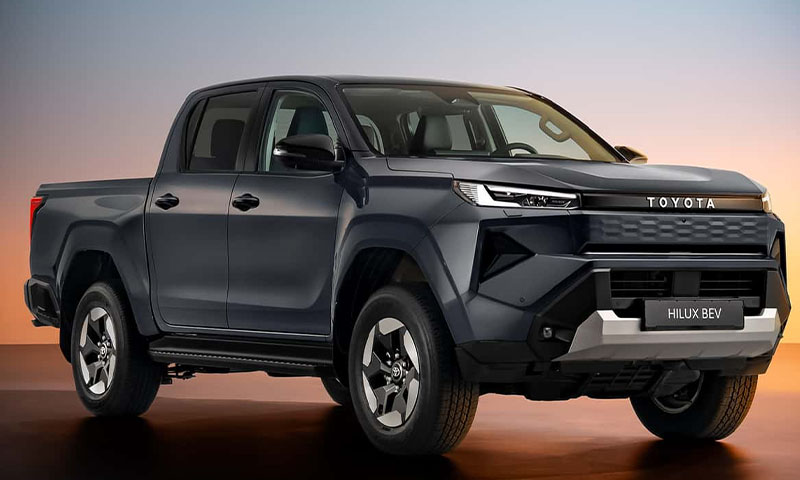
Toyota has announced the ninth generation of its legendary Hilux pick-up, ushering the model into a new electrified era with a battery-electric version among its multiple powertrain options. The global reveal — dated 10 November 2025 in Brussels — highlights Toyota’s “multipath” approach, offering customers various motives suited to local driving needs and conditions.
Key Highlights:
- The new Hilux lineup features a Battery Electric Vehicle (BEV) version, a 48V hybrid, and traditional diesel and petrol engines.
- The all-electric Hilux retains a body-on-frame construction, “invincible” durability, and rated capabilities around 715 kg payload and 1,600 kg towing capacity, with a WLTP-estimated range of approximately 240 km.
- The BEV uses a 59.2 kWh lithium-ion battery and all-wheel drive via front and rear e-axles. Off-road capability remains strong, with a wading depth retained.
- For Western Europe, the BEV model will roll out from December 2025. A hydrogen-fuel-cell version is also slated for release in 2028.
- Other upgrades across the model include digital user interface enhancements such as a 12.3-inch driver display, multimedia screen, electric power steering, and an upgraded Toyota T-Mate suite of safety systems with over-the-air updates.
Why It Matters
The new Hilux marks a major shift for Toyota’s pick-up segment. By incorporating a BEV variant, Toyota acknowledges the growing demand for electrified commercial and off-road vehicles. The multipath strategy provides flexibility for global markets to select powertrains based on infrastructure and customer needs. Even with traditional diesel/petrol options retained in certain regions, Toyota maintains the Hilux’s reputation for ruggedness and reliability.
Equally important: the upgrades to design, technology, and connectivity show Toyota wants the Hilux to appeal not just to hardworking fleets but also to lifestyle buyers seeking capability and modern features. With a well-rounded offering, Toyota is positioning the Hilux to be competitive globally in an era of transition toward zero-emission mobility.