Scientists Win 2025 Nobel Prize in Chemistry
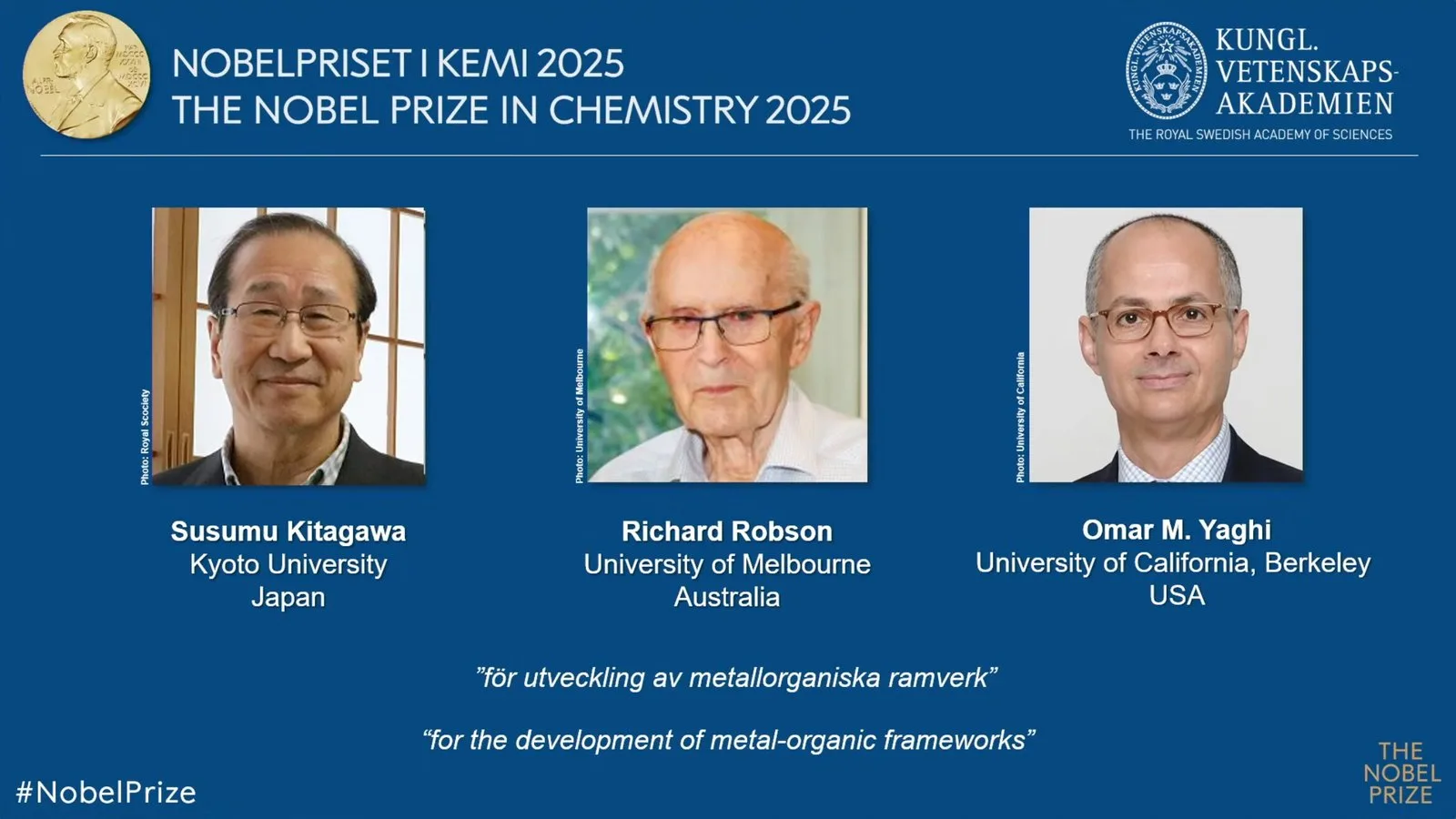
The 2025 Nobel Prize in Chemistry has been awarded to Susumu Kitagawa, Richard Robson, and Omar Yaghi for their groundbreaking development of metal–organic frameworks (MOFs) — a revolutionary class of materials with vast internal structures capable of storing and filtering gases at a molecular level.
Announced by the Royal Swedish Academy of Sciences on Wednesday, the trio will share the prestigious honor and a prize of 11 million Swedish crowns (approximately $1.2 million).
According to Heiner Linke, Chairman of the Nobel Committee for Chemistry, MOFs can be compared to "rooms in a hotel" — materials with immense inner cavities where guest molecules can move in and out freely. “A small amount of such material can store huge amounts of gas in a tiny volume — almost like Hermione’s handbag in Harry Potter,” Linke remarked during the announcement.
These porous molecular frameworks have a wide range of applications, including carbon capture, gas storage, water harvesting from desert air, and removal of toxic substances.
- Susumu Kitagawa serves as a professor at Kyoto University, Japan.
- Richard Robson is based at the University of Melbourne, Australia.
- Omar Yaghi is a professor at the University of California, Berkeley, USA.
The Nobel Committee praised the laureates for providing chemists with “new opportunities to solve global challenges” through their pioneering work in MOFs.
The Chemistry Nobel is the third major award announced in the 2025 Nobel Prize series, following those in medicine and physics earlier in the week. Established in 1901 through the will of Alfred Nobel, the inventor of dynamite, the prizes continue to honor outstanding contributions to science, literature, and peace.
Over the decades, the Chemistry Nobel has recognized several transformative breakthroughs, from nuclear fission to DNA sequencing. The 2024 award went to David Baker, John Jumper, and Demis Hassabis for their advancements in protein structure prediction and creation — a milestone in drug development and biotechnology.
This year’s award continues that legacy, celebrating innovation that merges chemistry with sustainability and global impact.
Related stories
 Technology
Windows 11 Context Menu Gets Cleaner, Faster Redesign
 Technology
No More Office Visits: MOFA Attestation Now Online
 Technology
Tesla Unveils Rocket-Powered Roadster, Production in 2028
 Technology
Aurangzeb Briefs World Bank, Fitch, Canada in Bangkok
 Technology
MOFA Launches Fully Digital Document Attestation System
 Technology