Pakistan Navy’s First Chinese Submarine to Join Fleet in 2026

BEIJING: The Pakistan Navy is set to induct its first Chinese-designed Hangor-class submarine into active service next year, Pakistan’s top naval commander, Admiral Naveed Ashraf, revealed in an interview with China’s Global Times. The move represents a major milestone in Pakistan’s maritime defense modernization and in China’s growing strategic footprint across South Asia and the Indian Ocean.
Under a $5 billion agreement signed between Islamabad and Beijing, Pakistan will receive a total of eight advanced diesel-electric attack submarines by 2028. The first four are being built in China, while the remaining four are being assembled in Pakistan — a significant boost to the country’s indigenous shipbuilding capacity and technical expertise.
Admiral Ashraf confirmed that the construction and delivery schedule of the Hangor-class submarines is “progressing smoothly.” Three of the submarines have already been launched into China’s Yangtze River from a shipyard in Hubei province. Once operational, these vessels are expected to enhance Pakistan’s maritime surveillance and defense capabilities across the North Arabian Sea and the Indian Ocean — areas of strategic importance given regional tensions with India.
The submarine deal also strengthens Pakistan’s long-standing defense partnership with China. Islamabad has been Beijing’s largest arms customer, accounting for over 60% of China’s total weapons exports from 2020 to 2024, according to the Stockholm International Peace Research Institute (SIPRI).
Admiral Ashraf praised Chinese defense technology, saying it is “reliable, technologically advanced, and well-suited to Pakistan Navy’s operational requirements.” He further noted that the navy is expanding its focus toward “emerging technologies such as unmanned systems, artificial intelligence, and electronic warfare,” in collaboration with China.
This development follows Pakistan’s growing integration of Chinese military hardware, including the use of J-10 fighter jets that reportedly downed an Indian Rafale aircraft earlier this year — a confrontation that surprised defense analysts and showcased the effectiveness of Chinese systems against Western-built aircraft.
Beyond military cooperation, the defense partnership aligns with Beijing’s broader strategic goals under the China-Pakistan Economic Corridor (CPEC), part of President Xi Jinping’s Belt and Road Initiative. CPEC, running 3,000 km from China’s Xinjiang region to Pakistan’s Gwadar Port, enhances China’s access to the Arabian Sea and provides a potential alternative to the Malacca Strait route for Middle Eastern energy imports.
Admiral Ashraf emphasized that “this cooperation goes beyond hardware; it reflects a shared strategic outlook, mutual trust, and a long-standing partnership.” He added that in the coming decade, collaboration will extend into research, technology transfer, training, and industrial co-development, marking a new phase in Sino-Pakistani naval relations.
Related stories
 International Politics
Trump Waives New Russia Sanctions; Moscow Hails Move
 International Politics
European Parliament Investigates French MEP Rima Hassan Over Alleged Israeli Flag Incident
 Pakistan
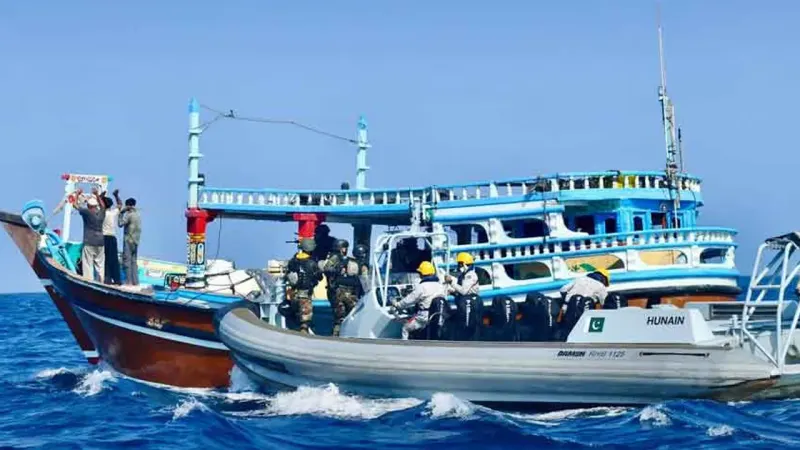
Navy Seizes Over 2,800kg Narcotics Worth $750m in Arabian Sea
 International
PM Shehbaz Backs China's Global Development Initiative, Calls for Peace
 International Politics
Russia, Iran Call for Diplomatic Solution to Crisis
 Trade
Trade