Justice Miangul Hassan Aurangzeb Elevated to Supreme Court
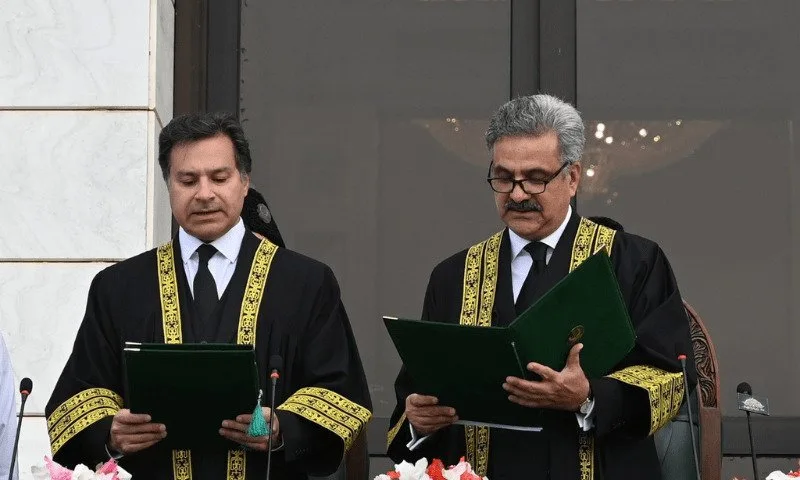
The Judicial Commission of Pakistan (JCP) on Tuesday elevated Justice Miangul Hassan Aurangzeb to the position of permanent judge of the Supreme Court (SC). The meeting, chaired by Chief Justice of Pakistan (CJP) Yahya Afridi, marked the commission's first session after the passage of the 27th Constitutional Amendment and the establishment of the Federal Constitutional Court (FCC).
Justice Aurangzeb had previously served as an ad hoc judge of the Supreme Court since February, following his elevation from the Islamabad High Court (IHC). His confirmation as a permanent judge reflects the commission’s support for his judicial contributions and experience.
Alongside this appointment, the JCP also approved two key high court elevations:
- Justice Zafara Ahmed Rajput as Chief Justice of the Sindh High Court (SHC)
- Justice Kamran Mullahkhail as Chief Justice of the Balochistan High Court (BHC)
During the meeting, the commission reviewed candidates for both high court positions, selecting from among the three senior-most judges in each respective high court.
These developments come during a period of significant structural reform in Pakistan’s judiciary. With the establishment of the Federal Constitutional Court—comprising four judges moved from the Supreme Court—and the resignations of Justices Mansoor Ali Shah and Athar Minallah, the total strength of the Supreme Court has dropped from 24 to 18 judges.
The meeting was attended by senior members of the judiciary and government, including FCC Chief Justice Aminuddin Khan, Justice Munib Akhtar, Justice Syed Hasan Azhar Rizvi, Justice Aamer Farooq, Attorney General Mansoor Usman Awan, Law Minister Azam Nazeer Tarar, and representatives from the Pakistan Bar Council and Parliament.
The 27th Constitutional Amendment also reshaped the composition of key legal bodies:
- Justice Jamal Khan Mandokhail was added to the Supreme Judicial Council (SJC) and the Practice and Procedure Committee.
- Justice Aamer Farooq of the FCC joined the Judicial Commission of Pakistan as a new member.
Among these bodies, the SJC remains the top forum for judicial accountability, the Practice and Procedure Committee oversees bench formation and case scheduling, and the JCP is tasked with appointments to the superior judiciary.
These shifts reflect a broader transformation in Pakistan’s judicial framework aimed at improved governance, accountability, and separation of constitutional responsibilities.
Related stories
 Middle East
Iran Backs Makkah Defence Pact, Ready to Join Unity Efforts
 Politics
PM Condoles Rashid Bashir Virk on Father’s Demise
 Government
PM: Govt Working to Ensure Decent Livelihoods for All
 Oil & Gas
Govt Prioritises Transparent, Competitive LPG Allocation
 Politics
Naqvi: Every Effort Made to Avoid Emergency in KP
 Politics